



Distribution and manufacturing companies hold an extremely valuable but untapped resource: transaction history and product catalog. OPTI Software has 20 years of experience in developing distribution and manufacturing software, B2B affiliation portals and ecommerce.
In the newly launched Guide #1: AI Recommendations, Upsell and Rules, we analyzed the real obstacles blocking AI adoption in B2B commerce. The conclusion is clear: for AI algorithms to deliver results, we must solve the "cleanliness" of data (Data Cleaning).
Here are 5 frequently identified scenarios and technical solutions for businesses seeking sales growth, from OPTI's experience in digitalization services.
1. The Chaos of Abbreviations
In many B2B databases, history has led to cryptic abbreviations. A product such as "Chrome kitchen faucet" appears in the ERP as "Chr. kitch. Fct.", which could also mean "kitchen food processor Chrome".
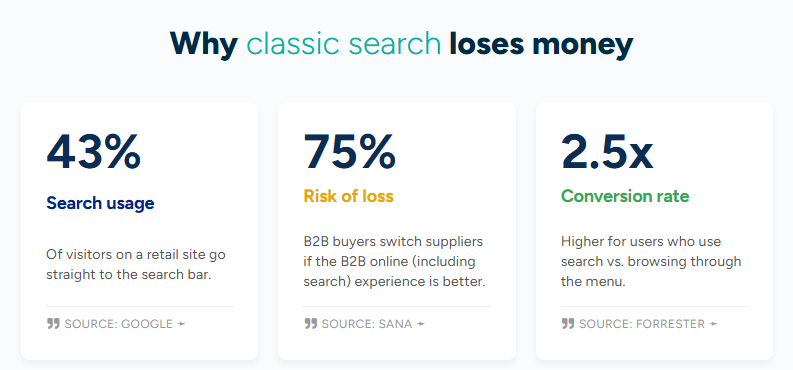
A standard search engine or generic AI will not make the semantic connection between the customer's search ("basin mixer tap") and the faucet inventory in the ERP.
The solution from the guide
Implementing hybrid search. This combines exact search (keywords) with vector search (semantic). With proper data processing, the system will "understand" that Fct. means Faucet in the context of plumbing installations. Guide 4 from the AI in B2B 2026 series will be dedicated extensively to this problem.
2. The Improvisation of Text Fields
A common limitation of legacy ERPs is the restricted number of fields for contact data. Classic cases occur where, unable to store multiple email addresses per customer, operators recorded them in the "Description/Notes" field, separated by commas.
An automated marketing or quoting system (or a CRM like HubSpot) cannot extract that data to send personalized offers.
The solution
Using automated extraction and structuring scripts (detailed in the "Data Contract" chapter of the guide), which parse the free-text "Description" field and correctly populate a modern CRM, then maintain synchronization.
3. The Tower of Babel of Measurement Units
Data inconsistency directly impacts the AI's ability to recognize and recommend compatible products. The same product can have its dimensions recorded as "1/2 inch", "0.5 in", "1/2'' ", and "12.7 mm" (alongside "127 mm", "1.27 cm" or "0.127 m").
The solution
The process of data normalization. Before training any AI model, data must pass through a standardization filter, so the algorithm knows that 0.5 in = 1/2. Without this step, recommendations for complementary products (e.g., pipe + fitting or rough-in kit) will fail. OPTI Software's experience is embodied in eight data checks we detail in the guide.
4. Colors and Addresses Noted Differently: Unstructured Attributes
One product can be listed as "green", another as "grn" (typo), another as "vert" (import) or "verde".
The system cannot deliver efficiently if "123 W. Washington St. Ste 400" is not correctly mapped alongside {"street": "West Washington Street", "suite": "400"}.
The effect is that filters and orders on the company's B2B affiliation portal cannot function correctly, and customers cannot find the products.
The solution
Unifying color attributes into a single ID (e.g., Color_ID: 23) and similarly for addresses. The guide explains how this cleaning process can be partially automated with LLM agents (e.g., Google Gemini or ChatGPT) to avoid doing the work manually.
From Data Cleaning to Sales Growth
Once the data is clean, advanced sales scenarios specific to B2B businesses and distribution can be activated, which we detail in the guide:
The Zero-Stock Problem: Intelligent Substitution
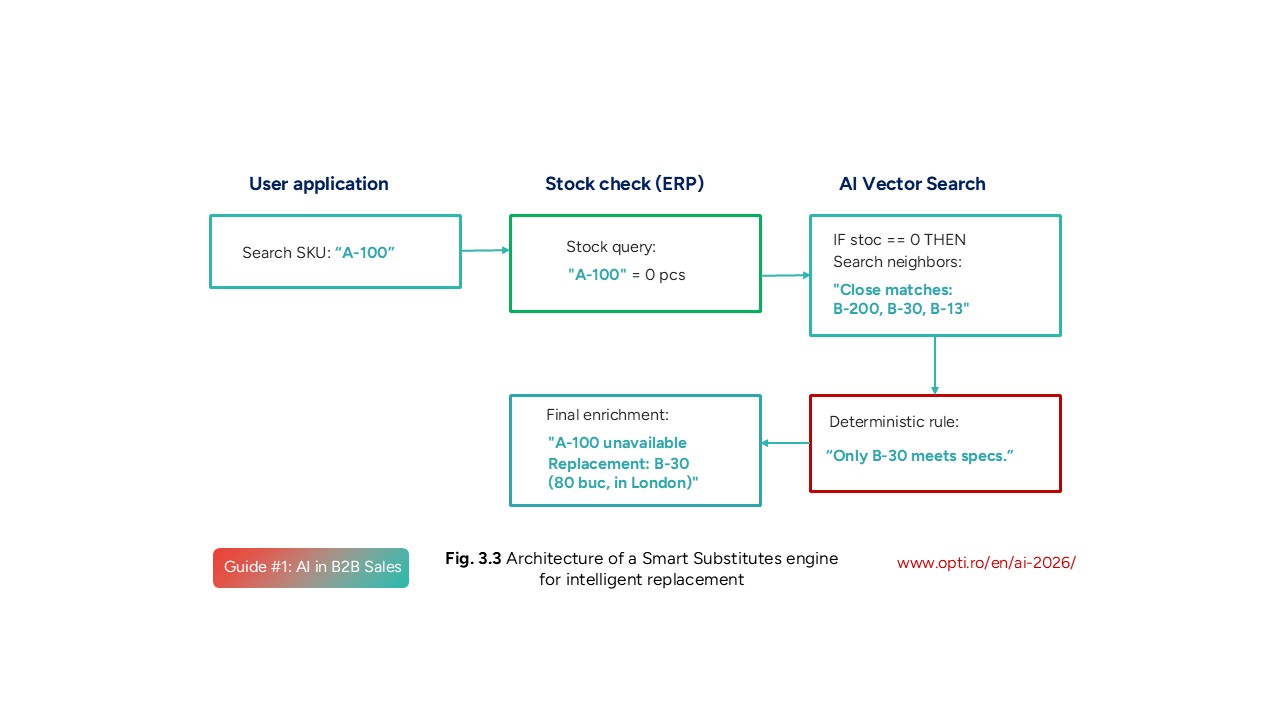
When a product is out of stock, the ERP displays an error. The sales agent tells the customer "We don't have it", and the customer goes to the competition.
The solution with artificial intelligence
The AI system can instantly suggest: "Product X is unavailable, but Y is technically equivalent (same diameter, same material) and is available in warehouse B". This saves the sale while applying the company's strict verification rules, based on the product specification sheet.
The Junior Agent Problem (Sales Copilot)
A new agent needs months to learn a catalog of 10,000 SKUs. Until then, they only take simple orders and miss the upsell.
The solution with artificial intelligence
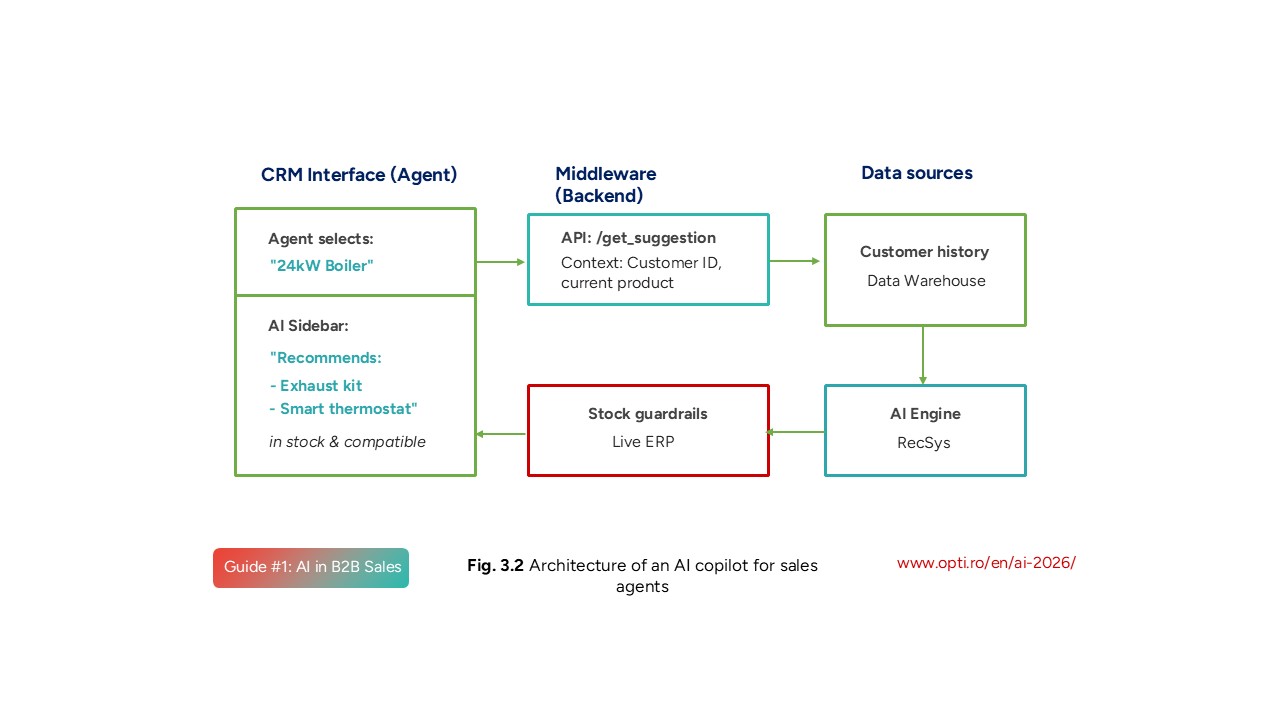
The AI approach: A digital "copilot" agent checks the cart in real time. If the customer requested a boiler, the AI reminds the agent: "For this model, the customer also needs the flue kit and thermostat. Add them to the quote?"
About Guide #1
These solutions are part of the Guide "Recommendations, Upsell and Rules", a reference document covering the hybrid AI architecture: how we connect legacy systems (ERP) with cloud artificial intelligence technologies, while maintaining control over prices and margins.
The guide is structured by roles (CEO, Technical, Commercial) and includes code examples, architecture diagrams, and budgeting strategies. It prepares businesses for AI implementation.
Why I Wrote This Guide
"I wrote it for entrepreneurs and sales directors who have gone through the fire of an ERP implementation and want to scale. For IT directors who built infrastructures from scratch and want to adapt them. For financial directors who need to justify innovation expenses. For architects who need to substantiate their decisions before the board. We don't promise magic, but engineering."
PhD Marian Călborean, Fulbright scholar, founder of OPTI Software