



Attending AI in Business Practice organized by Bee Global was, for me, one of those moments where you realize just how differently the same problem can be understood depending on the perspective you bring to it.
One of the most interesting things about the panel was that the same question received completely different yet complementary answers. And that is precisely what made the discussion valuable. Three perspectives were brought together on stage that, under normal circumstances, are rarely placed in the same conversation: business and software architecture, legislation and legal responsibility, and cybersecurity.
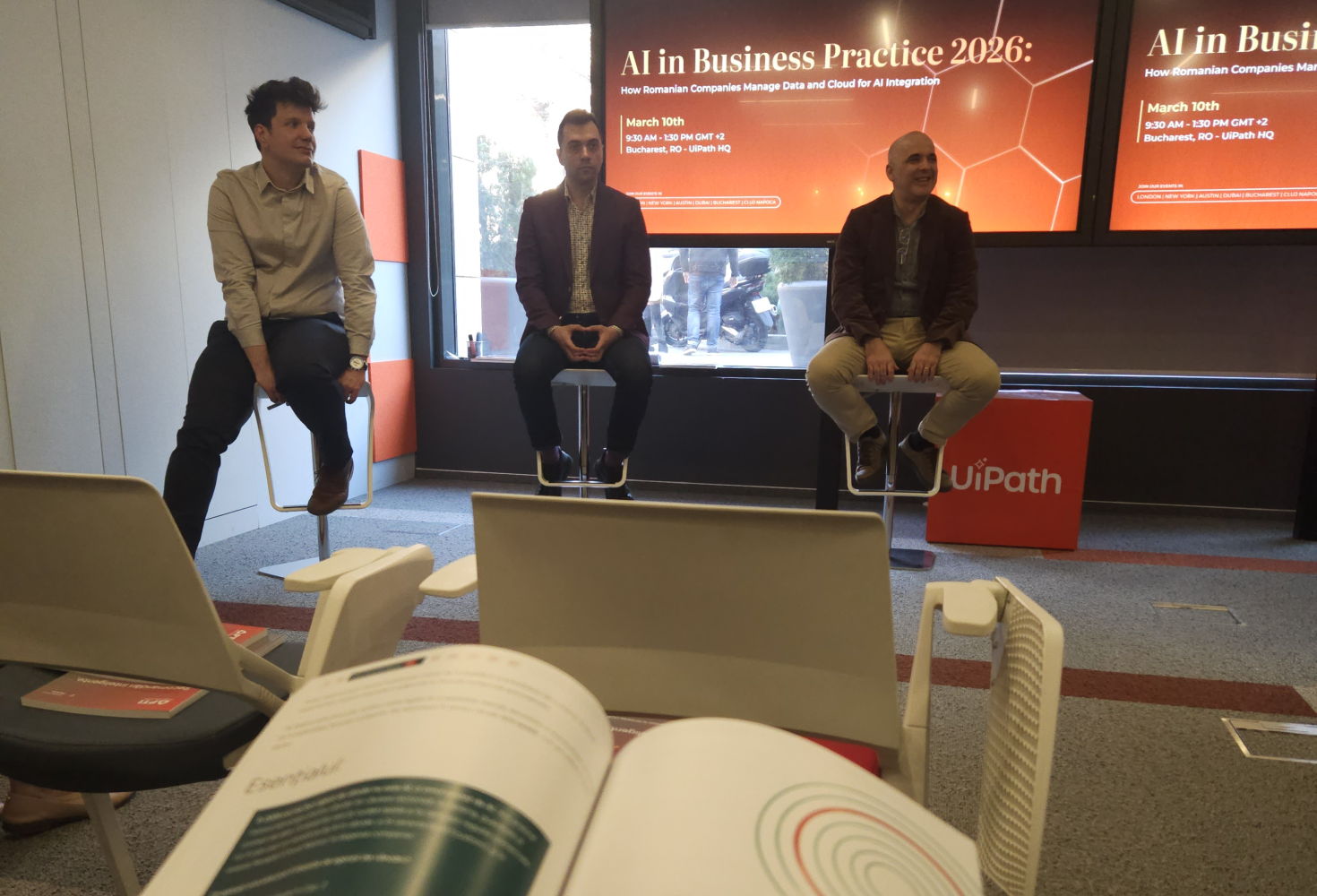
Caption: AI in Business Practice panel by Bee Global
The Business Perspective: Hybrid Implementation
From the business and technology side, Marian Călborean raised an important point: in B2B, AI does not work as a plug and play solution. There is no universal fix that solves everything overnight. Real implementation is an architecture problem. Most companies cannot afford to fully replace their existing systems, so the realistic approach is a hybrid one. You keep what you already have, organize your data, and build AI capabilities on top of it. It is a pragmatic perspective, but a necessary one.
The Legal Perspective: Who Is Accountable When AI Gets It Wrong?
Vadim Barbu added an angle that is frequently missing from conversations about AI: the legal dimension. What stood out was how he structured accountability across three distinct directions: employee, employer, and AI producer. In a context where technology evolves rapidly, clarity over responsibilities becomes essential. The discussion about legal risks was not theoretical but highly practical, offering a concrete framework for companies that want to adopt AI without taking on risks they do not fully understand.
The Cybersecurity Perspective: AI in Training and Education
From the cybersecurity side, Eduard Bîsceanu brought up a highly relevant use case: using AI in training and education. In a field where information changes constantly and the volume of required knowledge is difficult to cover, AI can become a genuine support layer for consultant teams. It does not replace expertise, but it amplifies it, helping teams cover more scenarios and build more effective training programs.
See how hybrid AI architecture traveled from Silicon Valley into B2B industries
What Made the Difference: Interactivity and Moderation
Another aspect that stood out was the level of interactivity. The audience engaged quickly with applied questions, pushing the discussion well beyond theory. The moderation by the Bee Global team contributed significantly to this, maintaining a solid pace and keeping the conversation relevant to the audience. BeeGlobal consistently manages to build this kind of dynamic energy around its events, regardless of the city.
Following the Bucharest edition, the next stop on April 29th is New York: "Safe AI and Business Guardrails: Applications in Google Cloud", where discussions continue in an international context with the same focus on a core challenge: how to move AI from experiment to real implementation without losing control over security, data, and governance.
Conclusion: AI Is Not Just a Technology Problem
In the end, the message is simple: AI is not just a technology problem. It is a combination of architecture, accountability, and security. Whether the conversation happens locally or in an international context, real value emerges when these perspectives are brought together rather than treated in isolation.
This was, for me, one of those panels where you leave not just with ideas but with a clearer understanding of the complexity behind them. A sign that what was discussed was genuinely valuable is when it makes you want to dig deeper. That is exactly what happened here, so I encourage you to follow the speakers and the projects they are building:
- Marian Călborean (OPTI Software) - applied guide on AI in sales
- Eduard Bîsceanu (Cyber Ranges) - cybersecurity training and simulation
- Vadim Barbu (Amgen) - legal perspectives on AI