





What can be delivered?
First, we discuss four myths regarding AI adoption in B2B. Then we present the ideal industries and ten deliverables that a mid-market company can finance in 2026.
Why AI is ideal for B2B
Most discussions about AI in sales start defensively: "it's harder for us," "the ERP is old," "we don't have enough data for AI," "B2B customers are special."
In reality, B2B has several structural advantages over B2C: recurring transactions, large baskets, relatively stable product codes, price lists, and clear commercial policies. These make a recommendation engine or a quoting system, paradoxically, easier to calibrate in B2B if the approach is hybrid.
Myth 1: Personal data and consent in B2B
Unlike invasive B2C tracking:
- In B2B, recommendations can be based on the company's transactional history (first-party data from ERP or CRM), not just on clickstream (personal data according to CCPA/CPRA/GDPR).
- The system will be more robust in the face of the recent disappearance of third-party cookies from e-commerce.
- Hybrid AI can leverage the data the company already owns.
Checking the legal basis for data holding and protecting customer data is mandatory. See guarantees in Ch. 5.3
Myth 2: AI on a small volume of data (Small Data)
Many companies avoid AI recommendations due to a misconception about the volume of data needed: "we are not Amazon." In fact, pre-trained models (e.g., Google) work for semantic search on any volume of data and for recommendations on small to medium transaction quantities (with historical import).
In B2B, there is a transaction history and well-defined commercial policies (usually).
- The Managed approach understands the concept of "phone" and "case" even in non-English languages. What it does not understand are the common abbreviations in legacy ERPs (e.g., "chr. kit. fau." for "chromed kitchen faucet"), which is why data cleansing is mandatory (see Ch. 2.5.2).
- The Build approach works for temporal forecasting even on relatively small amounts of data (e.g., stock depletion prediction).
- A hybrid approach can deliver the advantages of AI for B2B, with benefit measurement at every step, especially if the company's long history is imported.
See the implementation of the lexical and semantic mix in Guide #4: Hybrid Search
Myth 3: Speed and time-to-market
In B2B, many IT projects are not started because they take 1-2 years.
- There is a strategic difference between developing a Build (custom) system in 6-12 months with its associated risks and a Managed solution in 2-3 months with standard Google functionalities.
- Whoever manages to optimize their processes faster will gain market share.
- Hybrid architecture favors achieving fast results while maintaining safety.
Myth 4: Every B2B situation is special
Common in B2B is the need for control and safety:
- The company's reputation is at stake.
- There may be multi-inventory stocks, strict customer discount policies, personalized prices, and strict permissions per sales rep.
- The systems where the company keeps its logic (ERP) are the key to control.
- AI can bring benefits if it respects the company's logic.
What is difficult depends on size:
- The enterprise environment has a multi-branch, multi-account, multi-permission structure, which blocks the implementation of a global AI solution.
- For the mid-market, hybrid architecture deliverables can be implemented if there is a company source of truth. The ERP must not become a straitjacket and must be opened in a controlled manner.
 OPTI Product: Quoting platform for reducing time spent by sales reps
Three ideal projects
Before providing the promised list of ten concrete projects, here are three ideal projects that use AI for sales. Do they fit your needs?
| Dynamic customer segmentation | |
|---|---|
| Why? | What is the flow? |
| Price personalization |
|
| Compatibility-based cross-sell | |
|---|---|
| Why? | What is the flow? |
| Increasing customer value |
|
| Substitutes for out-of-stock items | |
|---|---|
| Why? | What is the flow? |
| Reducing churn |
|
These are three ideal examples that can be implemented in various forms. Below we present ten concrete deliverables to increase B2B sales.
Where does AI increase competitiveness?
Not all industries are equal from the perspective of AI implementation. Predictive AI (Gen 3) presented in Ch. 2.3 helps most the verticals where a few factors are present:
- Increased product complexity: Electrical, HVAC, construction, industrial.
- Repetitive but non-trivial decisions: Replenishments, consumables, spare parts.
- Medium or high basket value: To justify the implementation effort.
For them, a hybrid architecture produces clear competitive advantages: increasing order value and reducing quoting time and errors, without radically modifying the IT infrastructure.
The following are the global industries that have implemented AI most rapidly:
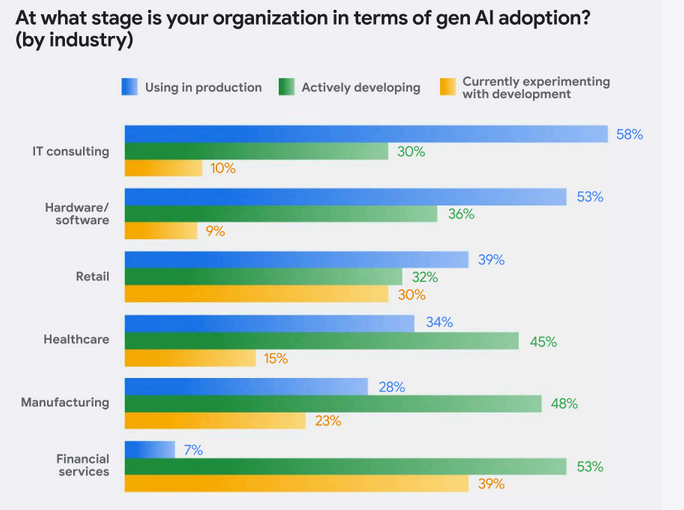
Here are four ideal industries for AI implementation via hybrid architecture, along with the justification for the choice.
Wholesale: Technical and IT distribution |
|
|---|---|
| Why? |
Varied margin in a competitive market.
A laptop has a 2% margin, but the bag and mouse have 40%.
|
| AI role: |
AI, through a recommendation system, "understands" the ideal basket and suggests accessories.
It can offer dynamic discounts in a controlled manner.
|
| KPI: | Increasing AOV (average order value). |
| Risks: | Irrelevant recommendations or discounts presented without brand image protection. |
Medical: Pharmaceutical equipment and consumables |
|
|---|---|
| Why? |
Recurring orders in a sensitive and regulated context.
Baskets are a mix of products that must respect protocols and compatibility. There are batches and expiration dates.
|
| AI role: |
Suggests consumables based on installed equipment and expirations.
Builds compatible bundles per procedure type.
Can offer discounts based on expiration date, FEFO logic (first expired, first out).
|
| KPI: | Reduced quoting errors, optimized stock rotation. |
| Risks: | Justified reluctance in a regulated context. Fear of technical incompatibilities. |
Construction: building materials |
|
|---|---|
| Why? |
Large baskets and varied margins.
Project-based orders, hundreds of items (e.g., cement, adhesives). Tiles have low margins, but profiles have good margins. |
| AI role: |
AI "understands" the type of work based on order lines and history. Suggests standard missing parts, accessories, and in-stock alternatives. |
| KPI: | Reducing quoting errors (follow-up "I forgot to get X" calls), increasing AOV. |
| Risks: | Fear of technical incompatibilities. |
Agricultural inputs: seeds, fertilizers, treatments |
|
|---|---|
| Why? |
Many products and possible recipes.
There is seasonal variation and variation by crop/plot. Customers desire bundles.
|
| AI role: |
AI "understands" the farm's needs based on a classification and proposes bundles.
Proposes alternatives when searched products are missing.
|
| KPI: |
Reducing quoting errors (decreases repetitive consulting).
Increasing AOV per season / crop / plot.
Differentiation through personalized recommendations per farm.
|
| Risks: |
Suspicion of generic recommendations.
Lack of internet connection for reps in the field.
|
These are just a few examples of industries with complex products, repetitive (but non-trivial) decisions, and at least average basket value.
Can't find your industry here? In AI News, we discuss the latest AI technologies for 2026–2027Ten AI projects for B2B sales
A B2B company manager considering integrating intelligent recommendations doesn't instantly visualize e-commerce widgets with "others also bought." He will first analyze the gap between what customers want and what he can currently deliver with his sales team.
In almost any B2B implementation, AI recommendations become complex engines for commercial strategy. AI proposes, rules decide.
The company is primarily interested in projects which it can implement with a positive ROI. For this reason, we present ten deliverable applications, which are variations of the three ideal projects in Ch. 3.1.5.
They can be realized on the architecture described in this guide, without rewriting the ERP and without blocking current operations.
NOTE: We mark with applications that require AI functionalities beyond those native to the Managed approach at the time of writing this guide. For the different types of AI models needed (time forecasting and dynamic discounting), see Ch. 2.1.4
Assisted selling
Sales rep copilot |
|
|---|---|
| Side panel in CRM or ERP, or as an overlay on top of legacy ERPs (e.g., AS/400, old Epicor) | |
| Why? |
Multi-channel team (e.g., field, telesales) missing opportunities, inexperienced junior reps.
|
| AI role: |
Recommends contextual upsell or cross-sell for the sales rep, e.g., during the call.
With a custom model, it also recommends the Next Best Action, e.g., "send them an e-mail". A chatbot (assistant) can be added, see Guide #4. |
| KPI: |
Quoting time.
Average Order Value (AOV).
Adoption rate/Rate of target achievement within the sales team.
Negative rep feedback: "report wrong recommendation."
|
| Risks: |
CRM data quality.
The human factor (reps may reject the system).
|
| Flow: |
Data is sent from CRM to AI, a recommendation is sent to the side panel, and push notifications are sent to the rep.
|
Architecture diagram
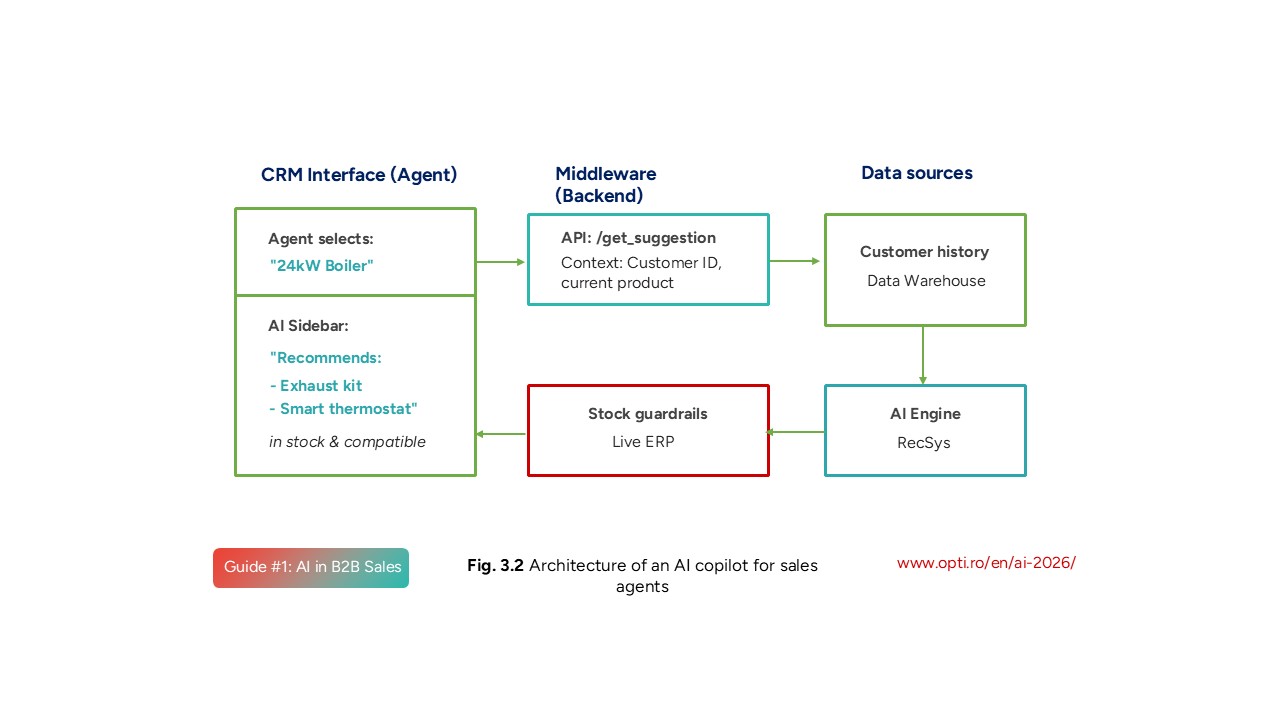
      CRM INTERFACE (Rep)               MIDDLEWARE (Backend)                  DATA SOURCES
┌───────────────────────────────┐     ┌───────────────────────────┐     ┌───────────────────────────┐
│ Rep selects:                  │     │ API: /get_suggestion      │     │ CUSTOMER HISTORY          │
│ "24kW Boiler"                 │────>│ (Context: Customer ID,    │────>│ (Data Warehouse)          │
├───────────────────────────────┤     │  current product)         │     └─────────────┬─────────────┘
│ SIDEBAR AI:                   │     └───────────────────────────┘                   │
│ "Recommends:                  │                                                     ▼
│  - Exhaust kit                │     ┌───────────────────────────┐     ┌───────────────────────────┐
│  - Smart thermostat"          │<────│ STOCK RULES               │<────│ AI ENGINE                 │
│ (stock + compatible)          │     │ (Live ERP)                │     │ (RecSys)                  │
└───────────────────────────────┘     └───────────────────────────┘     └───────────────────────────┘
Checklist: What to examine for AI implementation
| Integration with current platforms | Minimum data and necessary latency |
| Defining business rules | Continuous learning and negative feedback |
Case Study: Quoting automation with Google Cloud
Saving the sale
Smart Substitutes Engine - Smart replacement |
|
|---|---|
| Intelligent product substitution when out of stock, for faster rotation, or for delivery from a single location. | |
| Why? |
Saving the sale when stock is 0 (e.g., auto, IT, construction, pharma) due to supply issues or fast distribution.
Transport optimization when multiple warehouses are present (WMS).
|
| AI role: | Suggests many possible equivalents (different brand, similar specifications) available for immediate delivery, which are then checked by deterministic rules. |
| KPI: |
Conversion rate for out-of-stock products (direct or mediated e-commerce).
Inventory turnover for alternatives.
Lost sales (rejected quotes).
|
| Risks: |
Recommending a technically incompatible product (maximum return risk).
WMS integration complexity for transport optimization.
|
| Flow: |
AI is used to suggest the closest products, filtered strictly by compatibility rules (requires clean, normalized data).
Then the margin and delivery distance are optimized.
|
Architecture diagram
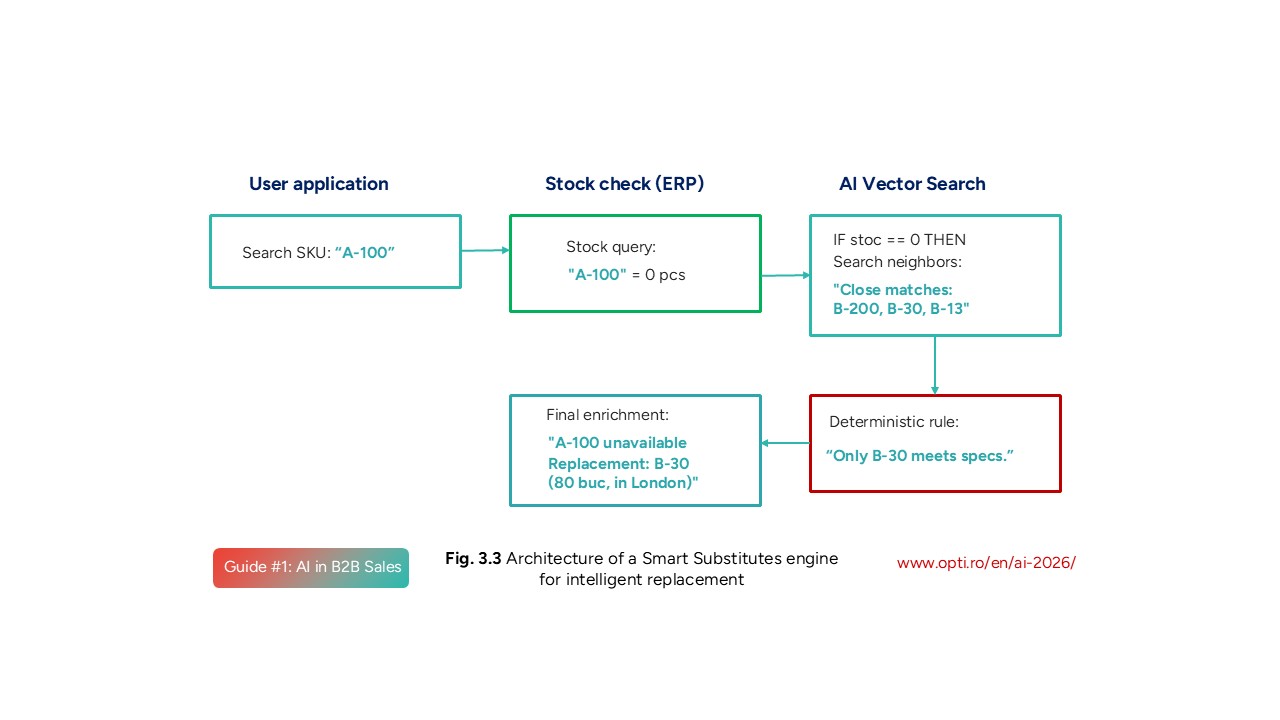
   USER APPLICATION                   STOCK CHECK (ERP)                   AI VECTOR SEARCH
┌─────────────────────────┐       ┌───────────────────────────┐       ┌───────────────────────────┐
│ Search SKU: A-100       │ ─────>│ Stock query:              │ ─────>│ IF stock == 0 THEN        │
└─────────────────────────┘       │ "A-100" = 0 pcs           │       │ Search neighbors:         │
                                  └───────────────────────────┘       │ "Close matches:           │
                                                                      │  B-200, B-30, B-13"       │
                                                                      └─────────────┬─────────────┘
                                                                                    │
                                                                                    ▼
                                  ┌───────────────────────────┐       ┌───────────────────────────┐
                                  │ FINAL ENRICHMENT:         │       │ DETERMINISTIC RULE:       │
                                  │ "A-100 unavailable        │<───── │ Only B-30 meets specs.    │
                                  │  Replacement: B-30        │       └───────────────────────────┘
                                  │  (80 pcs, in London)"     │
                                  └───────────────────────────┘
Checklist: What to examine for AI implementation
| Minimum data and required data volume | Data cleanliness and normalization |
| Technical compatibility rules | Stock rotation and lost offers |
Dynamic Bundling
Dynamic Bundling Generator |
|
|---|---|
| Creating dynamic bundles to increase turnover without destroying positioning | |
| Why? |
Liquidating slow-moving (stagnant) stock without destroying the unit list price.
|
| AI role: | Suggests bundles of bestsellers plus slow-moving products, based on conversion probability. A bundle discount is then added (classically or AI-based). |
| KPI: |
Inventory turnover for old products.
Commercial margin per bundle vs. separate sale with discount.
Bundle acceptance rate (dynamic)
|
| Risks: |
Cannibalization of sales for bestsellers.
|
| Flow: |
AI suggests stagnant products likely to be accepted together with bestsellers (or basket products). A business rule is applied:
"If combined margin >15%, offer common 5% discount." The proposal appears in the application.
|
Architecture diagram
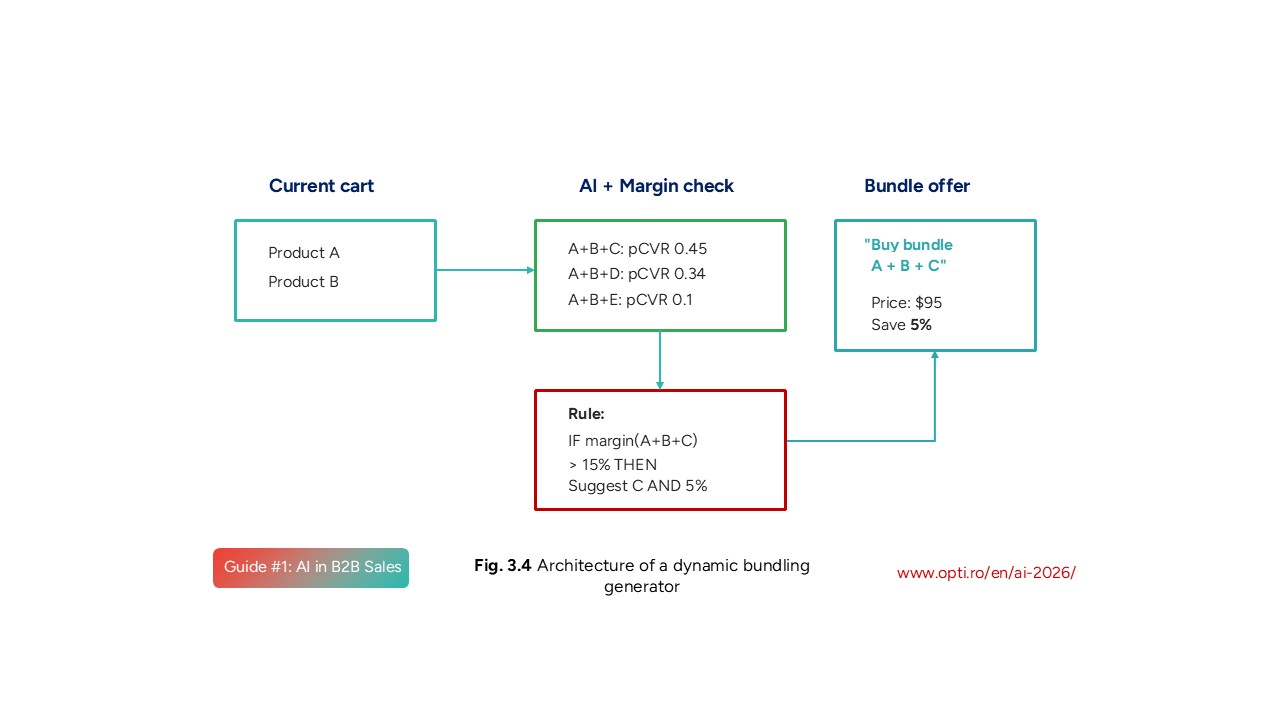
       CURRENT CART                     AI + MARGIN CHECK                     BUNDLE OFFER

┌─────────────────────────┐       ┌───────────────────────────┐       ┌───────────────────────────┐
│ [Product A]             │       │ A+B+C: pCVR 0.45          │       │ "Buy bundle"              │
│ [Product B]             │ ─────>│ A+B+D: pCVR 0.34          │ ─────>│ [A + B + C]               │
└─────────────────────────┘       │ A+B+E: pCVR 0.1           │       │                           │
                                  └─────────────┬─────────────┘       │ Price: 95 USD             │
                                                │                     │ (save 5%)                 │
                                                ▼                     └───────────────────────────┘
                                  ┌───────────────────────────┐
                                  │ RULE:                     │
                                  │ IF margin(A+B+C)          │
                                  │ > 15 THEN                 │
                                  │ Suggest C AND 5%          │
                                  └───────────────────────────┘
Checklist: What to examine for AI implementation
| Minimum data and required data volume | Integration with current platforms |
| Defining business rules | Stock rotation |
B2B Cross-sell
"Frequently Bought Together" Module With Compatibility Check |
|
|---|---|
| The classic "People who bought this also bought...", but calibrated for B2B | |
| Why? |
Increasing the basket size in B2B online stores or distributor portals that are stagnating.
|
| AI role: | Identifies strong correlations (e.g., "Those who buy pipe, also buy fittings") based on historical orders. |
| KPI: |
Average number of lines per order.
Attach Rate of accessories to the main product.
|
| Risks: |
Banal recommendations (e.g., "Those who bought paper also bought pens").
Confusion between complementary products ("fitting A for pipe A") and possible substitutes ("do you want pipe B with that pipe A?"). |
| Flow: |
The model is trained on transaction history from recent years.
Strong correlations between SKUs are identified. Filters are applied for compatibility and category.
Suggestions are made in the application.
|
Architecture Diagram
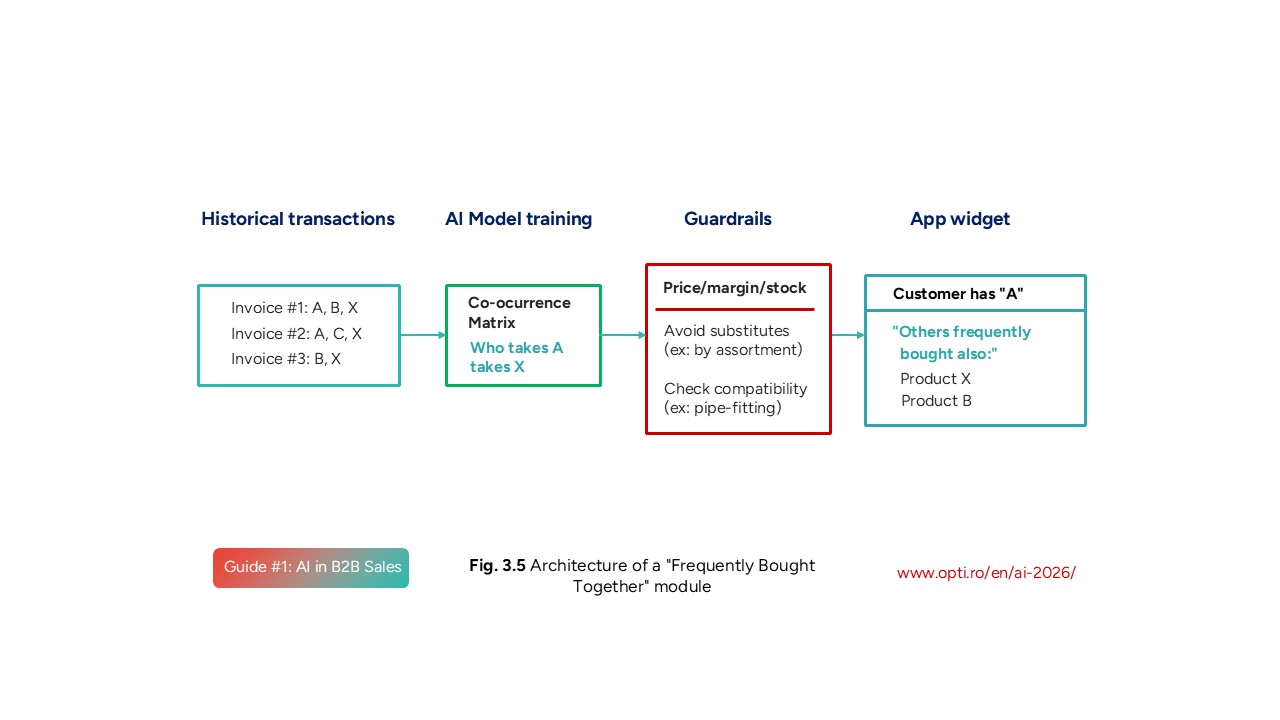
  HISTORICAL TRANSACTIONS                AI MODEL TRAINING                  GUARDRAILS                    SITE WIDGET

┌─────────────────────────┐       ┌───────────────────────────┐       ┌─────────────────────┐       ┌──────────────────┐
│ Invoice #1: A, B, X     │       │                           │       │ Price/Margin/Stock  │       │ Customer has "A" │
│ Invoice #2: A, C, X     │ ─────>│ CO-OCCURRENCE MATRIX      │ ─────>├─────────────────────┤ ─────>├──────────────────┤
│ Invoice #3: B, X        │       │ (Whoever takes A takes X) │       │ Avoids substitutes  │       │ "Customers often │
└─────────────────────────┘       │                           │       │ (e.g., by category) │       │  also buy:"      │
                                  └───────────────────────────┘       │ Check compatibility │       │  [Product X]     │
                                                                      │ (e.g., pipe-fitting)│       │  [Product B]     │
                                                                      └─────────────────────┘       └──────────────────┘
Checklist: What to examine for AI implementation
| Minimum data and required data volume | Integration with current platforms |
| Banal correlations to eliminate | Periodic model training |
Churn Prevention
Smart Replenishment |
|
|---|---|
| A system that learns the consumption cycle of each customer and proposes replenishment | |
| Why? |
Recurring business (e.g., consumables, restaurant supply) where customers forget to order or switch suppliers.
|
| AI role: | Predicts the stock depletion date for the customer and sends a proactive reminder (e.g., email). If a farm buys seeds seasonally, the system alerts it (for fixed repetition, non-AI methods exist). |
| KPI: |
Retention rate of recurring customers.
Order frequency (time between orders).
Email CTR.
|
| Risks: |
Negative perception (if too aggressive).
|
| Flow: |
Time series are analyzed on the order history per customer. Detects real seasonality (e.g., buys in March and December).
A notification is sent to the customer. It can be extended for demand forecasting.
|
Architecture Diagram
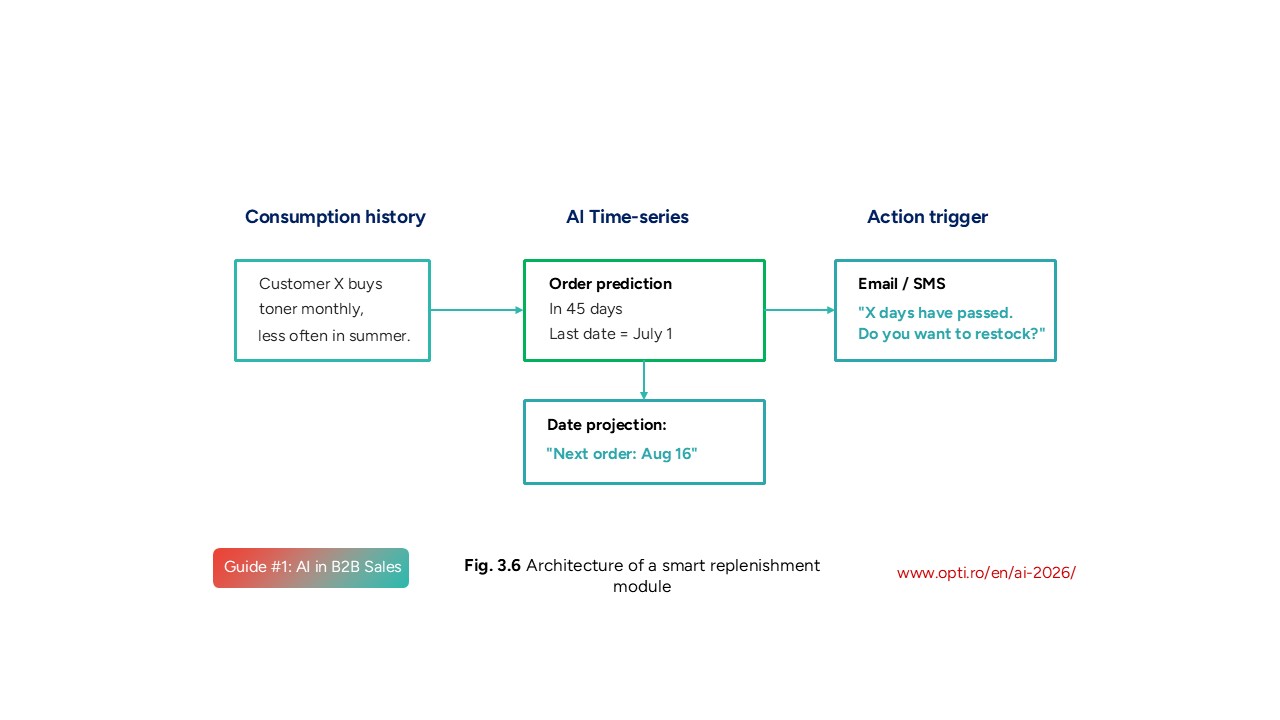
    CONSUMPTION HISTORY                    AI TIME-SERIES                     ACTION TRIGGER

┌───────────────────────────┐       ┌───────────────────────────┐       ┌───────────────────────────┐
│ Client X buys toner       │       │ Order prediction:         │       │ EMAIL / SMS               │
│ monthly, less often       │ ─────>│ In 45 days                │ ─────>│ "X days have passed.      │
│ in summer.                │       │ Last date = July 1        │       │  Do you want to restock?" │
└───────────────────────────┘       └─────────────┬─────────────┘       └───────────────────────────┘
                                                  │
                                                  ▼
                                           DATE PROJECTION:
                                        "Next order: Aug 16"
Checklist: What to examine for AI implementation
| Integration with current platforms | Minimum data and required data volume |
| Defining business rules | Continuous learning and negative feedback |
B2B Portal Personalization
Netflix-style B2B Portal |
|
|---|---|
| Hyper-personalization of a page in Netflix style. Although B2B customers usually know what they are looking for, it can be used to display categories or new products of interest. | |
| Why? |
Huge product catalogs or taxonomies where customers waste time reaching products relevant to their niche.
|
| AI role: |
Reorders products, categories, and banners based on industry and history.
A plumber sees pipes and fittings, while an electrician sees cables and fuses.
|
| KPI: |
Time to add to cart.
Bounce rate (site abandonment).
Click-through rate (CTR).
|
| Risks: |
Over-fitting. The customer no longer sees other categories: 10-30% of products should be kept unpersonalized (for discovery).
|
| Flow: |
Customer segmentation in (near) real-time based on browsing behavior (clickstream). Widgets in the B2B portal
are re-ordered.
|
Architecture Diagram
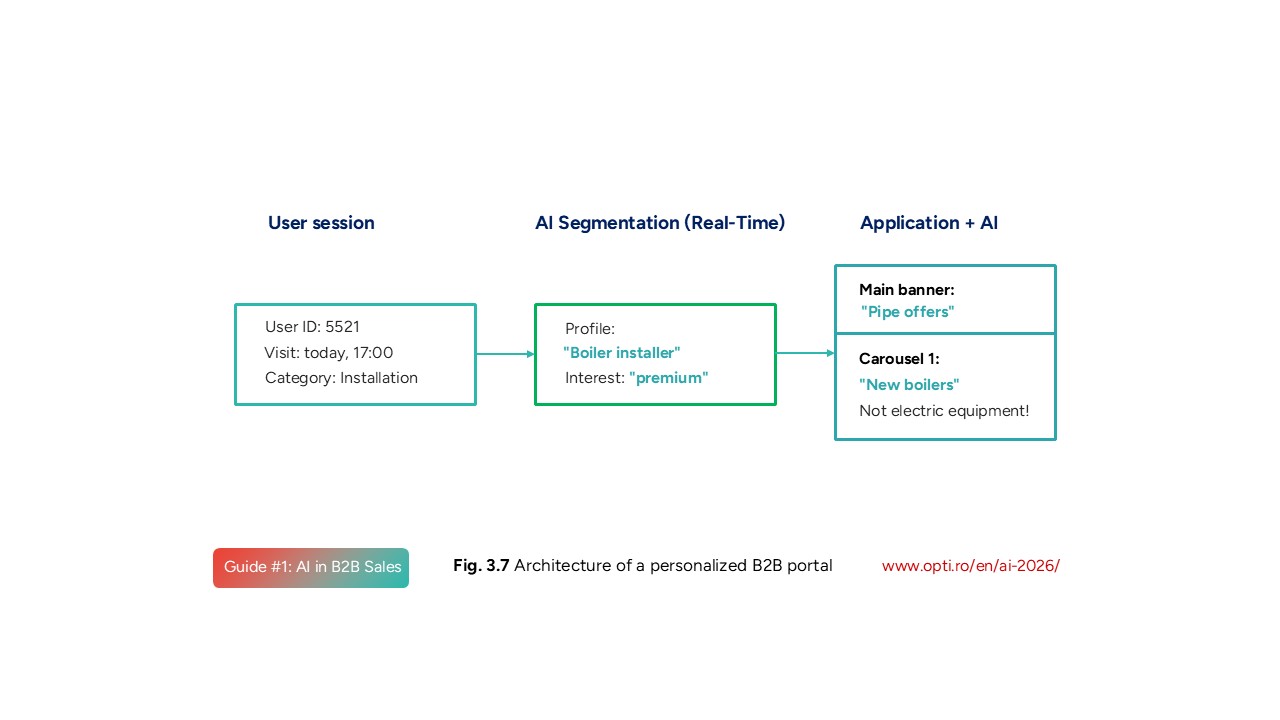
        USER SESSION                 AI SEGMENTATION (Real-Time)             APPLICATION + AI

┌───────────────────────────┐       ┌───────────────────────────┐       ┌───────────────────────────┐
│ User ID: 5521             │       │ Profile:                  │       │ MAIN BANNER:              │
│ Visit: today, 17:00       │ ─────>│ "Boiler installer"        │ ─────>│ "Pipe offers"             │
│ Category: Installation    │       │ Interest: "premium"       │       ├───────────────────────────┤
└───────────────────────────┘       └───────────────────────────┘       │ CAROUSEL 1:               │
                                                                        │ "New boilers"             │
                                                                        │ (Not electric!)           │
                                                                        └───────────────────────────┘
Checklist: What to examine for AI implementation
| Minimum data and required data volume | Time lost for searching |
| Customer segmentation possibilities | Continuous learning and negative feedback |
Case Study: Creating a B2B affiliate portal for e-commerce
Hyper-personalization
Contextual Abandoned Cart Recovery |
|
|---|---|
| Using B2B information on stocks, delivery terms, technical specifications in communicating with customers. | |
| Why? |
Conversion of unfinished carts in high-traffic/low-conversion scenarios.
|
| AI role: | Email with technical sheets, limited stock, or logistical offers, across several typologies, generatively optimized: "Since you are Gold, we are letting you know we only have 2 left." |
| KPI: |
Cart recovery rate.
Unsubscribe rate.
|
| Risks: |
Negative perception (e.g., too aggressive when basket is pending approval)
Out-of-stock offers.
|
| Flow: |
Hyper-personalized text is generated based on data, with checks (e.g., stock).
Marketing CRM is integrated (e.g., HubSpot, Salesforce). The notification is sent.
|
Architecture Diagram
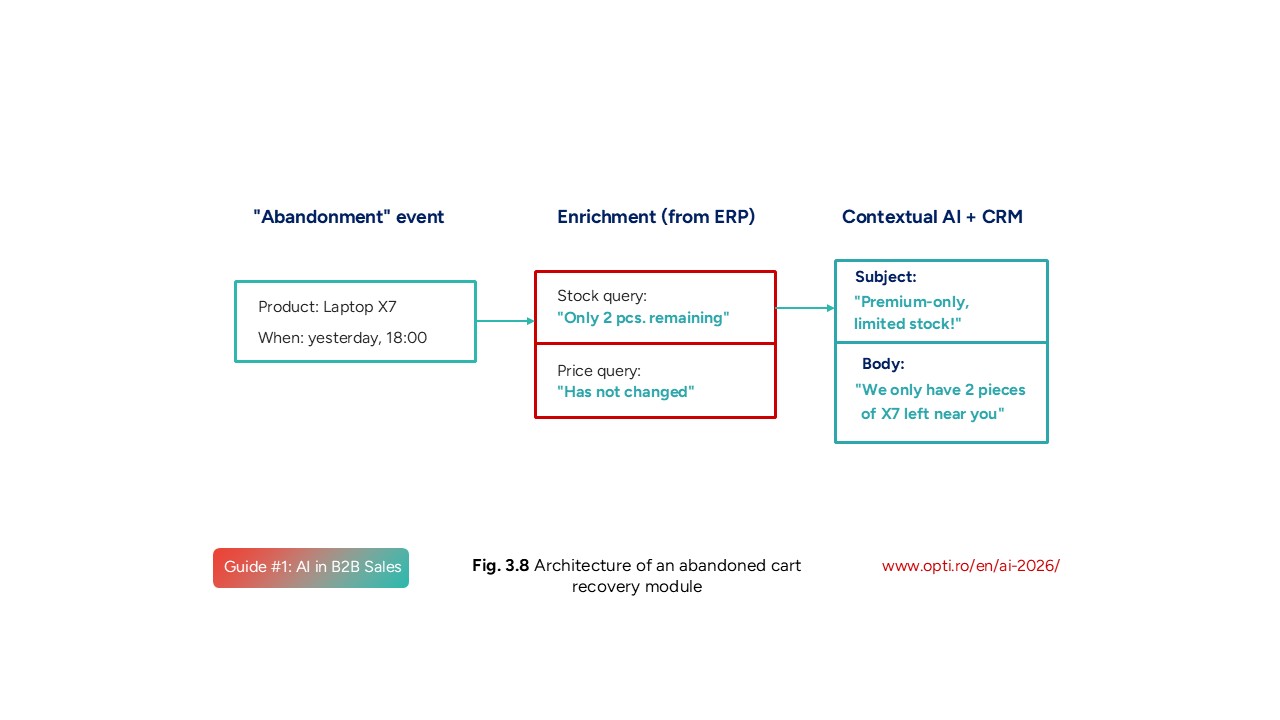
      EVENT "ABANDONMENT"                ENRICHMENT (FROM ERP)               CONTEXTUAL AI + CRM

┌───────────────────────────┐       ┌───────────────────────────┐       ┌───────────────────────────┐
│ Product: Laptop X7        │       │ Stock query:              │       │ Subject:                  │
│ When: yesterday, 18:00    │ ─────>│ "Only 2 pcs. remaining"   │ ─────>│ "Premium-only,            │
└───────────────────────────┘       ├───────────────────────────┤       │  limited stock!"          │
                                    │ Price query:              │       ├───────────────────────────┤
                                    │ "Another 24h"             │       │ Body:                     │
                                    └───────────────────────────┘       │ "We only have 2 pieces    │
                                                                        │  of X7 left near you"     │
                                                                        └───────────────────────────┘
Checklist: What to examine for AI implementation
| Minimum data and required data volume | Rate and reasons for cart abandonment |
| Possible data for personalization | Collection of negative feedback |
Technical Compatibility
Proactive Alert Engine |
|
|---|---|
| Preventing the sale of incompatible products through deterministic rules or high-confidence AI recommendations. | |
| Why? |
Reducing logistical costs caused by returns: technically incorrect orders in automotive, IT, DIY, and electrical sectors.
|
| AI role: | Detects anomalies in the cart (e.g., Intel CPU + motherboard with AMD socket) and suggests verification for the customer. Can work on unstructured descriptions or on the return history. |
| KPI: |
Return rate.
Number of support tickets.
|
| Risks: |
False positive cases (incorrect alerts).
|
| Flow: |
Data is structured and rules are defined.
AI checks the cart products before checkout with a high confidence level. Adjusted through testing.
|
Architecture diagram
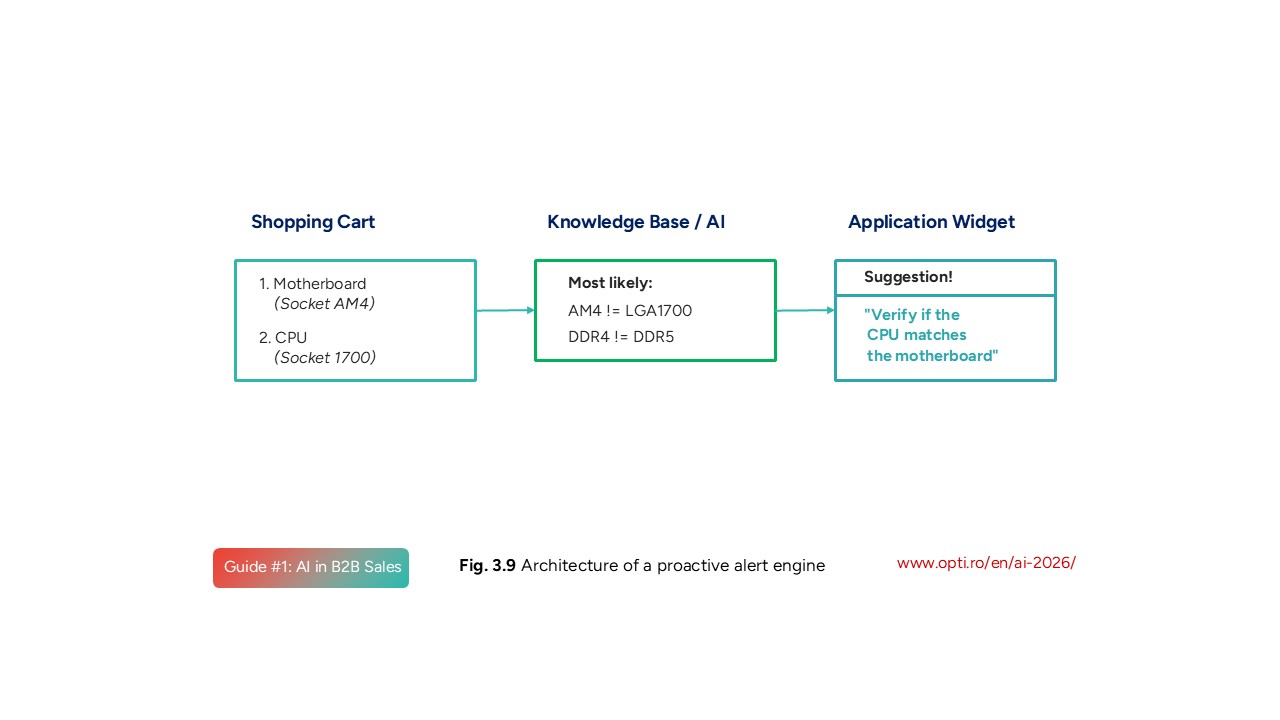
       SHOPPING CART                     KNOWLEDGE BASE/AI                   APPLICATION RESULT

┌───────────────────────────┐       ┌───────────────────────────┐       ┌───────────────────────────┐
│ 1. Motherboard            │       │ RULES:                    │       │ SUGGESTION!               │
│    (Socket AM4)           │ ─────>│ AM4 != LGA1700            │ ─────>├───────────────────────────┤
│ 2. Processor              │       │ DDR4 != DDR5              │       │ "The processor/RAM        │
│    (Socket 1700)          │       │                           │       │  may not match the        │
│ 3. DDR4 RAM               │       └───────────────────────────┘       │  motherboard!"            │
└───────────────────────────┘                                           └───────────────────────────┘
Checklist: What to examine for AI implementation
| Minimum data and required data volume | Necessary confidence level |
| Defining business rules | Continuous learning and negative feedback |
Rapid promotion of new products
New product recommendation engine (Cold Start solution) |
|
|---|---|
| Critical for industries with wide catalog and frequent launches (e.g., IT, fashion, DIY), so that new products do not die in page 50+. | |
| Why? |
New products (collections, 2026 ranges) lack sales history and do not appear in classic recommendations (Gen 1-2).
|
| AI role: | Analyzes descriptions, attributes, images, and documentation (e.g., CAD) with Content-Based capabilities (Gen 3). In vectors, Range 1 2027 is close to Range 4 2026, so relevance is transferred. |
| KPI: |
Time to first sale.
Percentage of active catalog (products with sales).
|
| Risks: |
AI hallucinations (e.g., screws associated with nails).
See Guide #2.
Too high priority for new items (especially vs in-stock products). |
| Flow: |
New products are identified at specific intervals (batch).
They can be found, suggested, or recommended to customers who buy from that category from the first listing day.
|
Architecture diagram
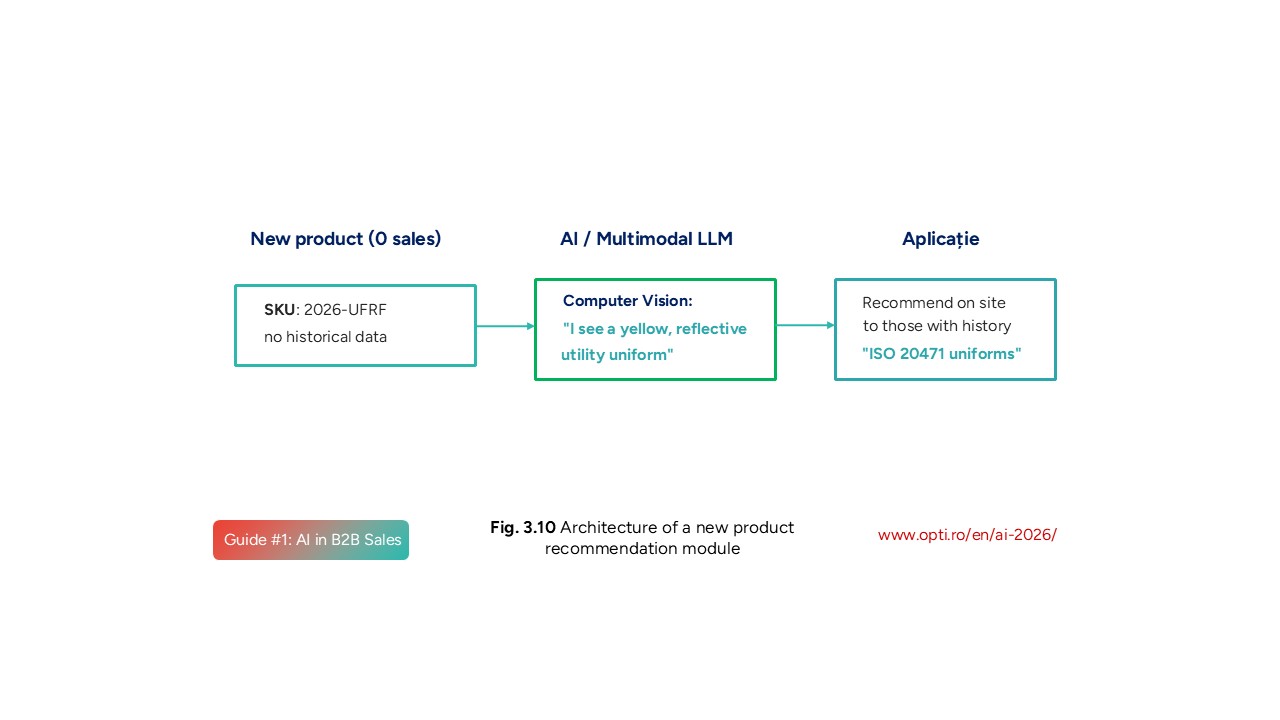
     NEW PRODUCT (0 SALES)               AI / MULTIMODAL LLM                     APPLICATION

┌───────────────────────────┐       ┌───────────────────────────┐       ┌───────────────────────────┐
│ SKU: 2026-UFRF            │       │ Computer Vision:          │       │ Recommend on site         │
│ (no historical data)      │ ─────>│ "I see a yellow           │ ─────>│ to those with history     │
└───────────────────────────┘       │  reflecting uniform"      │       │ "ISO 20471 class 1-3"     │
                                    └───────────────────────────┘       └───────────────────────────┘
Checklist: What to examine for AI implementation
| Minimum data and required data volume | Integration with current platforms |
| New product documentation | Prevention of hallucinations |
Dynamic price optimization and negotiation
Discount intelligence engine |
|
|---|---|
| Recommends the optimal discount range to the rep to close the sale, Uber-style. | |
| Why? |
Reps give the maximum discount out of habit. The company wants to save the margin.
|
| AI role: | Estimates the probability of conversion at full price and suggests the minimum necessary discount. Uses custom AI models to optimize profit, not conversion. |
| KPI: |
Margin
Success rate (win rate).
Average discount granted.
|
| Risks: |
Reputation and compliance risk if not applied across all channels in a controlled and documented (explainable) manner.
Availability of data regarding real margins.
The human factor: reps could reject the system.
|
| Flow: |
Offer data, both won and lost, is continuously extracted.
A classification model is used to learn price elasticity.
Live scores are obtained for each cart.
|
Architecture diagram
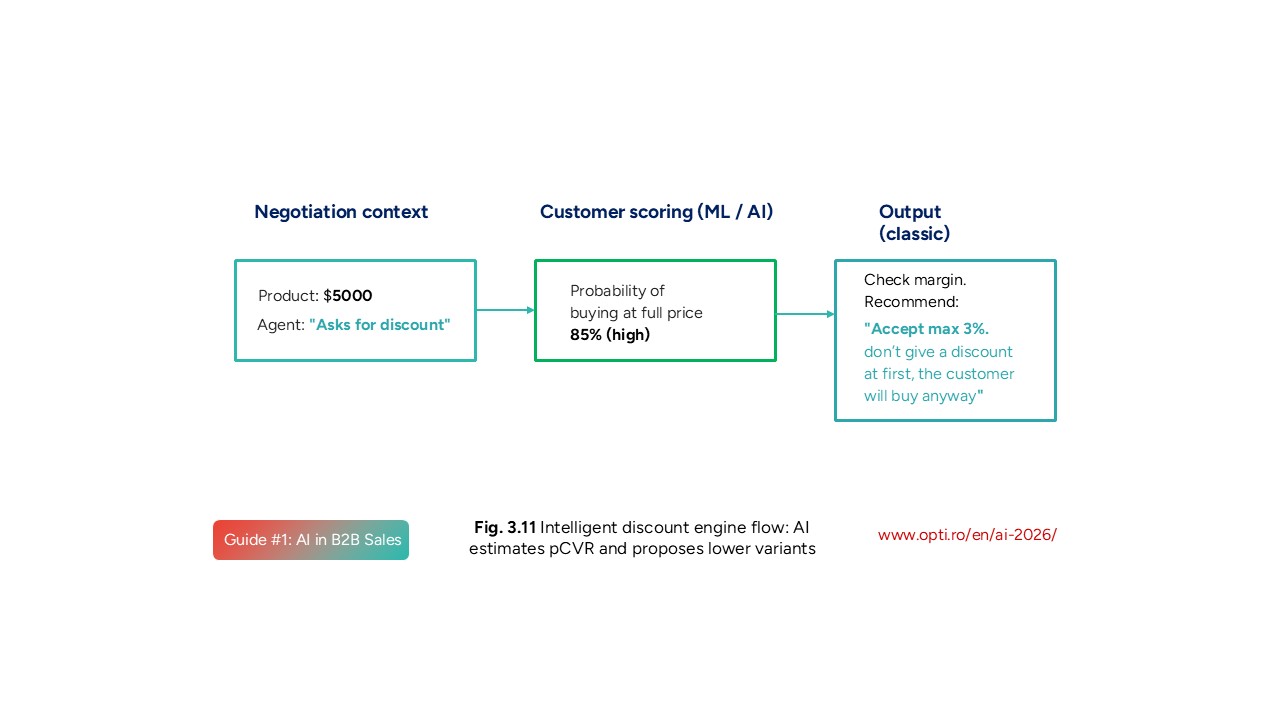
     NEGOTIATION CONTEXT               CUSTOMER SCORING (ML/AI)               OUTPUT (CLASSIC)

┌───────────────────────────┐       ┌───────────────────────────┐       ┌───────────────────────────┐
│                           │       │                           │       │ CHECK MARGIN.             │
│ Product: 5000 USD         │       │ Probability of            │       │ RECOMMEND:                │
│ Rep: "Wants discount."    │ ─────>│ buying at full            │ ─────>│ "Accept max 3%"           │
│                           │       │ price: 85% (high)         │       │ (don't offer discount     │
└───────────────────────────┘       └───────────────────────────┘       │  at first, the customer   │
                                                                        │  will buy anyway)         │
                                                                        └───────────────────────────┘
Checklist: What to examine for AI implementation
| Minimum data and required data volume | Compliance risks |
| Change management and training | Data on lost offers |
These ten deliverables are not magic, but engineering. We must account for risks to deliver opportunities. We detail several technical ingredients for building these deliverables in Ch. 4.
The bottom line:
Setting myths aside, B2B also has advantages over B2C for AI implementation. These ten deliverables can be built, each with a mandatory risk and profitability analysis.
For example, AI temporal analysis is very powerful for seasonality (e.g., agriculture), and dynamic price optimization can be ideal if there is strict control and compliance verification.
The role of AI in B2B sales is to bring plausible options forward and reduce search time. Implementation follows the commercial strategy and receives continuous feedback (positive and negative) to learn the company's niche. See Guide #5. Optimization and reporting
Want to see what deliverables make sense for your industry? You can discuss with the author.
Continue Exploring
Quick Questions
Which types of AI applications deliver real value in B2B?
Those that reduce team effort and increase decision consistency: contextual cross-sell, stock-validated bundling, assisted replenishment, and personalized portals focused on efficiency rather than discovery.
Why focus on deliverables instead of AI models?
Because businesses buy operational outcomes, not architectures. Models are a means, not the objective.
Which projects deliver the fastest visible impact?
Product-page cross-sell, simple bundling, and abandoned cart recovery in recurring purchasing contexts. These scenarios usually have sufficient data and relatively low risk.
How is the Cold-Start problem handled?
By using product attributes, commercial rules, and, where relevant, external signals. AI does not start from zero if data is structured correctly.
What risks appear most frequently in these applications?
Out-of-stock recommendations, unauthorized discounts, and over-personalization that confuses users. This is why every deliverable must be tied to KPIs and guardrails.
What is the TLDR (conclusion)?
This chapter converts architecture into roadmap-ready deliverables: each with minimum data needs, flow, KPIs and risks (especially where contracts, availability and reputation matter).
What technologies and methodologies are involved?
Technologies: ERP, CRM, BigQuery, Vertex AI, Vertex AI Search, Vertex AI Search for commerce, APIs, Email/Notifications, Analytics, Looker
Methodologies: risk-impact prioritization, deliverable definition, KPI design, scenario guardrails, account segmentation, incremental testing, controlled rollout, drift monitoring