


When can I grow the business?
Note: OPTI Software is a Google Cloud and HubSpot partner. The guides express our position and have not been supported or approved by Google.
Guide summary
As a summary of the previous chapters, the most important ideas are:
AI for sales is a pipelineIt is not a single model, but a sequence of steps: Data Events Candidates Ranking Guardrails UX Feedback loop. |
|
B2B has advantages in adoptionLarge baskets and recurring transactions make AI recommendations and automated quoting possible. |
|
Hybrid architecture is the safest choiceThe combination of Deep Learning, strict business rules, and clean data ensures growth without redesigning the company's IT infrastructure. |
|
Build if you have plenty of data and a solid teamThe Build (custom) approach is recommended for organizations with machine-learning teams and solid data. |
|
Managed if you want quick resultsThe Managed (Cloud Native) approach is recommended for fast results with less infrastructure. |
|
Data quality and KPIs before anything elseAI cannot work magic on dirty data. Establishing measurable KPIs helps the organization in adoption. |
|
Evolution of rolesAI transforms the sales rep into a negotiator and consultant. |
Here are the resources needed for success and how you can calculate your costs.
What does a realistic cost model look like?
For AI integration in B2B, costs are not a black box. Even when a provider offers a single price, the project is inevitably split into Setup (integration, data, rules, testing) and Run (operation, monitoring, adjustments).
We present them separately for clarity and so that the budget correctly reflects the reality of the implementation. For specialists, Setup is CAPEX (investment), and Run is OPEX (operations).
First, we present the cost structure (human resources, external services, and the two phases). Then we include a cost matrix. You can, therefore, get a pen ready.
Human resources
We saw in the implementation stages in Ch. 4.1 that sales, marketing, finance, and IT departments can be involved in AI adoption. For the project to support business growth, not only technical roles are important. That's why we start with the business roles.
Business roles
|
Sponsor: |
Product Owner / Sales Ops |
Key users: |
|
|
|
Technical roles
|
Architect: |
Specialists: |
Developers and integrators |
|
|
|
In the Build version, requirements for data and ML engineering increase significantly. In the Managed version, the focus is on configuring external services, data flows, and business rule control.
Typical third-party services
Even companies with strong internal teams frequently outsource some activities:
|
Audit and architecture
|
|
|
Data cleansing
|
|
|
Implementation
|
|
|
Training and change management
|
|
|
Expansion and optimization
|
 Case Study: Financial sentiment analysis with GenAI & Google Cloud
Setup vs Run
From a financial perspective, costs can be grouped into two phases.
Setup: Initial Construction
Includes all typical services up to production launch:
- Usually has a limited duration.
- Involves intense effort from the external partner and internal roles.
- In the Build version, the share of development costs is high.
- In Managed, development costs are lower.
- In both versions, the cost of data integration and cleansing is significant.
Run: Operation, maintenance, experimentation
Includes recurring cloud costs, monitoring and maintenance of services, testing, and support:
- Typically, a variable cost based on resources, correlated with traffic and bidding volume.
- Plus a fixed cost for integration maintenance, which can be reduced if the company maintains data quality.
- Plus a variable or fixed effort cost for external or internal roles.
- In the Build version, an important part is the effort for ML, SRE, and code maintenance.
- In the Managed version, an important part is cloud (pay as you go).
In brief:
- Major parts of the project are audit and architecture (including the data contract) and cleansing historical data.
- In most projects, the Setup cost is more pronounced in the first phase, and the Run cost becomes dominant as the use of the sales engine grows.
- A realistic cost model must take both components into account and relate them to revenue objectives: AOV, conversion rate, time saved for quoting.
- In practice, some companies adopt a hybrid approach: they use Managed services for recommendations and search, but keep intellectual property components such as internal scoring models in the Build version.
The AI budget
With a good understanding of your own company and a few easily confirmed assumptions about the IT market, you can calculate an estimated cost range using the tables below.
The CFO can view AI as a digital employee. It has a recruitment and onboarding cost (Setup = CAPEX) and a monthly salary (Run = OPEX), going on to work 24/7 for the company, under continuous health and working condition monitoring.
We group the percentages below according to company type:
- SMB / Generic: Small catalog, relatively simple data, standard ERP.
- Mid-market / Distribution: Large catalog, long transaction history, uncleaned data, legacy ERP, complex pricing logic.
- Enterprise: Internal data team, maximum security and customization requirements.
1. Setup: Initial Construction
Where are the architecture and development days consumed?
| Phase | SMB / Generic | Mid-market / Distribution | Enterprise |
|---|---|---|---|
|
Audit and architecture Data audit, data contract, defining guardrails, defining flows, technical architecture. |
~15% (10-20%) |
~30% (25-35%) |
~25% (20-30%) |
|
Data cleansing Normalization, deduplication, data completion, anti-degradation procedures, and synchronization with the source (e.g., ERP). |
~15% (10-25%) |
~30% (25-40%) |
~20% (15-30%) |
|
Implementation For SMB and Mid-market, we assume Managed. For Enterprise, the Build version can reach ~70% |
~40% (30-50%) |
~25% (20-35%) |
~40% (30-55%) |
|
Testing and launch A/B, shadow mode, validation with the sales team |
~20% (15-25%) |
~10% (8-15%) |
~10% (8-15%) |
|
Training "Train the trainer", adoption, and feedback processes |
~10% (5-15%) |
~5% (3-8%) |
~5% (3-8%) |
|
(additional) On-prem architecture Hardware, DevOps, sys admin |
+~20% (~15-25% ) |
||
Notes
- The percentages above are indicative (budgetary allocation) and do not represent an offer.
- They vary from vendor to vendor with catalog size, data quality, security requirements, and number of sales channels.
- For a typical B2B distributor, ~60% of the budget will be used before configuring the AI component (with the Managed version), especially for data cleansing.
2. Run: Operation, maintenance, experimentation
| Component | Estimate | Variables |
|---|---|---|
|
Cloud licenses |
~5-15% of Setup / year |
Volume. Cost increases (and can increase significantly) if you are successful. It is a "pay-as-you-go" cost, measurable against ROI. |
|
Maintenance and support |
~15-25% of Setup / year |
Stability. Monitoring integrations (e.g., |
|
Data cleansing |
0-15% of Setup / year |
Discipline. If dirty data appears in the ERP, it will have to be cleaned regularly. Automation reduces this cost but does not eliminate it. |
|
(additional) On-prem architecture |
~15-25% of Setup / year |
Maintenance. On-prem tends to require personalized maintenance and support. |
Notes
- The percentages above are indicative (budgetary allocation) and do not represent an offer.
- We include the Google Cloud cost calculator in the Glossary - Resources. You can find similar calculators for other platforms.
For a long-term cost evolution vision, we believe that as AI tools become more powerful, raw execution costs (data cleansing and implementation) will decrease as a percentage.
Value and, implicitly, the budget will move towards analysis and architecture. The advantage will belong to those who know what to build and how to integrate the result into business workflows.
In brief:
- Invest in data quality, as it brings a permanent long-term benefit, with or without AI. For regional businesses, it often is the primary niche differentiator.
- Adopt AI for growth. As shown by the indicators in Ch. 1, companies successful in adopting AI are those that have committed to growth and development. Bare efficiency gains struggle to justify the substantial cost of audit and architecture. But these can be perfectly justified as investment in future revenue.
- To reduce Setup costs, you can adopt a standardized middleware (SaaS) for interacting with the AI engine. You can save part of the implementation effort, with fewer customization options. One such platform is Sales with AI from OPTI Software, which increases sales team efficiency.
Sales with AI - Quoting Software for sales team efficiency
Safety and quality
We explain Google's policies and guarantees, along with the quality methodology of OPTI Software, when using hybrid architecture for AI in sales.
See information about SOC 2, HIPAA, NIS2/GDPR and ISO 27001 compliance in Guide #6Google's Guarantees
The proposed architecture is based on four fundamental promises from Google, which are public.
Data privacy and trade secrets
Google's policy is explicit and contractual: data remains the company's property. Data is stored and processed in the region chosen by the customer out of those available.
|
"Google Cloud never uses customer data to train our models … without the customer’s prior permission." Source: Google Cloud - Delivering trusted and secure AI Whitepaper 2025 |
Sales history and pricing strategies are not used to train other customers' models (without explicit permission). Currently, for Vertex AI Search, the location can also be US / EU multi-region, while Vertex AI Search for commerce has a global location only.
Grounding in company truth
Google supports the principle of "Grounding in Enterprise Truth" and provides tools for minimizing AI hallucinations.
|
"Using genuine, reliable data vastly improves the trustworthiness of a model’s output – which in turn helps build users’ trust and confidence in its abilities." Source: Google Cloud - Delivering trusted and secure AI Whitepaper 2025 |
The core data consists of what the company holds in its systems (ERP, CRM, e-commerce). In a hybrid architecture, AI results are additionally filtered and enriched with "warm" data (just-in-time).
Flexibility and portability
Google promotes an open architecture, "Open Cloud":
|
"Google Cloud offers both first-party and third-party AI models in the Vertex AI Model Garden. This is part of our open philosophy … a core belief in giving customers maximum choice without forced lock-in." Source: Google Cloud - Delivering trusted and secure AI Whitepaper 2025 |
If you implement the Build (custom) version on Google Cloud, you can export all business logic, data, and models, reducing significantly the risk of customer lock-in.
If you use Google Cloud via the Managed version, the pre-trained model cannot be exported. However, data, events, and configurations can be exported. Migration would involve training a new model or adopting a pre-trained model from another vendor (e.g., Amazon Personalize in AWS).
Predictable costs for scalability
In the vast majority of use cases, the cost model is variable ("pay-as-you-go"), based on actual resource consumption (per calls/resource), rather than fixed licenses.
|
OPTI Software Methodology
Founded in 2005, OPTI Software has implemented multiple technologies, vendors, and channels. In our AI projects, the partnership with Google for cloud and HubSpot for CRM (e.g., Breeze agents) elegantly resolves the tension between innovation (selling more) and control (not selling at a loss of margin or brand image).
Our 20 years of experience in custom development are the foundation for successfully integrating AI with existing software.
The quality principles recommended in this guide do not depend exclusively on one vendor. OPTI Software additionally includes mandatory checks for every project.
Data cleansing
To specify the Data Contract from Ch. 2.5.2 and achieve operational clarity, we perform eight checks:
| No | Check | Questions |
|---|---|---|
|
Understanding taxonomy |
Is the product and customer taxonomy clear? Is it hierarchical? All successful B2B companies have developed expert systems (Gen 1) in their ERP, controlling product and customer categories. Proprietary business flows are built upon this taxonomy. |
|
|
Completeness |
Are essential fields missing? E.g., product descriptions, categories, technical attributes? Without descriptions, semantic search with AI is useless. |
|
|
Consistency |
Are there inconsistent values for the same thing (e.g., "m", "meter", "pc", "pcs", "piece","LLC", "L.L.C.", "Inc.")? AI will only understand internal abbreviations after normalization. |
|
|
Accuracy |
Are there obvious errors? E.g., negative prices, product codes with invalid characters, sales without a specified customer. AI cannot guess nonexistent data. |
|
|
Deduplication |
Are there duplicate products or customers? E.g., the same physical product or the same customer with multiple codes. Duplicates poison AI relevance. |
|
|
Legacy data |
Are there old fields or codes that are no longer used but still exist in the system? They can poison recommendations if they dominate semantically without being active. |
|
|
Standardization and denormalization |
For data consistency, are "4x2" and "2x4" or "DN40" and "D.N.40" handled? Are addresses kept as text "123 W. Washington St. Ste 400"
but also in separate fields |
|
|
Anonymization and pseudo-anonymization |
For compliance and data protection, what data should not reach the AI? Do we need to generate fictitious but unique names to replace real ones? We maintain data consistency while avoiding legal risks. |
Note: Data cleansing is partially automated using LLMs (e.g., Google Gemini) and should be a core service offered by AI implementers. OPTI Software develops proprietary scripts that can be executed by AI agents under the supervision of a data engineer with full auditability. The involvement of the company for domain knowledge is essential.
Case Study: Analytics in BigQuery for the gaming industry
Guardrails and company truth
In the Managed version, Google offers ServingConfigs to control recommendations. As in the Build (custom) version, these are useful for defining business rules (guardrails) for company safety.
In B2B applications or middleware, our procedures always consider:
- Prices
- Stock levels
- Margin
- Compatibility
- Logistical restrictions
- Packages and bundling
- Permissions
- Minimum Order Quantity (MOQ)
- Company image protection
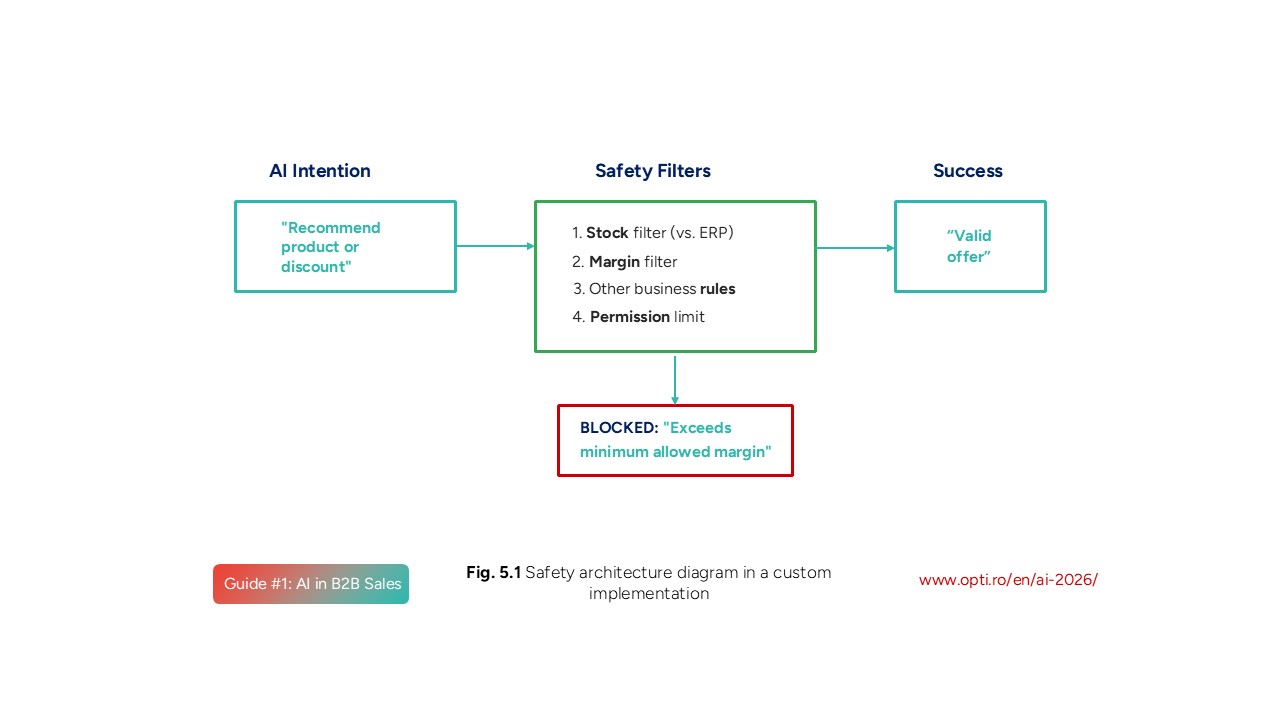
        AI INTENTION                       SAFETY FILTERS                         SUCCESS

┌───────────────────────────┐       ┌───────────────────────────┐       ┌───────────────────────────┐
│ "Recommend product        │       │ 1. Stock filter (vs. ERP) │       │                           │
│  or discount"             │ ─────>│ 2. Margin filter          │ ─────>│ VALID OFFER               │
│                           │       │ 3. Other business rules   │       │                           │
└───────────────────────────┘       │ 4. Permissions limit      │       └───────────────────────────┘
                                    └─────────────┬─────────────┘
                                                  │
                                                  ▼
                                    ┌───────────────────────────┐
                                    │ BLOCKED: "Exceeds minimum │
                                    │ allowed margin"           │
                                    └───────────────────────────┘
Based on the principle of grounding in company truth, we recommend:
| No | Step |
|---|---|
|
0 |
Keeping the company's source of truth unmodified |
|
1 |
Filtering at the API level through business rules before sending the response to the customer or rep
|
|
2 |
Querying stock, price, and permissions just-in-time |
|
3 |
Attention to customer-specific prices: AI returns Product_id, and the site will query the ERP for Price_customer_Y.
|
|
4 |
Attention to speed and using a fast caching layer (especially if the ERP is on-prem) |
Explainability
For decision transparency, we can use Google's Explainable AI tools, augmented with dynamic business rule explanations, providing reps with not just a recommendation output, but the reasoning behind it. While there are limits at the moment, the argument for the recommendation is available (partially) in the Managed version as well, not just in Build.
An AI system might only explain "score 0.95" or "primary reason: X", whereas a hybrid system can also explain reaching a stock limit via guardrails.
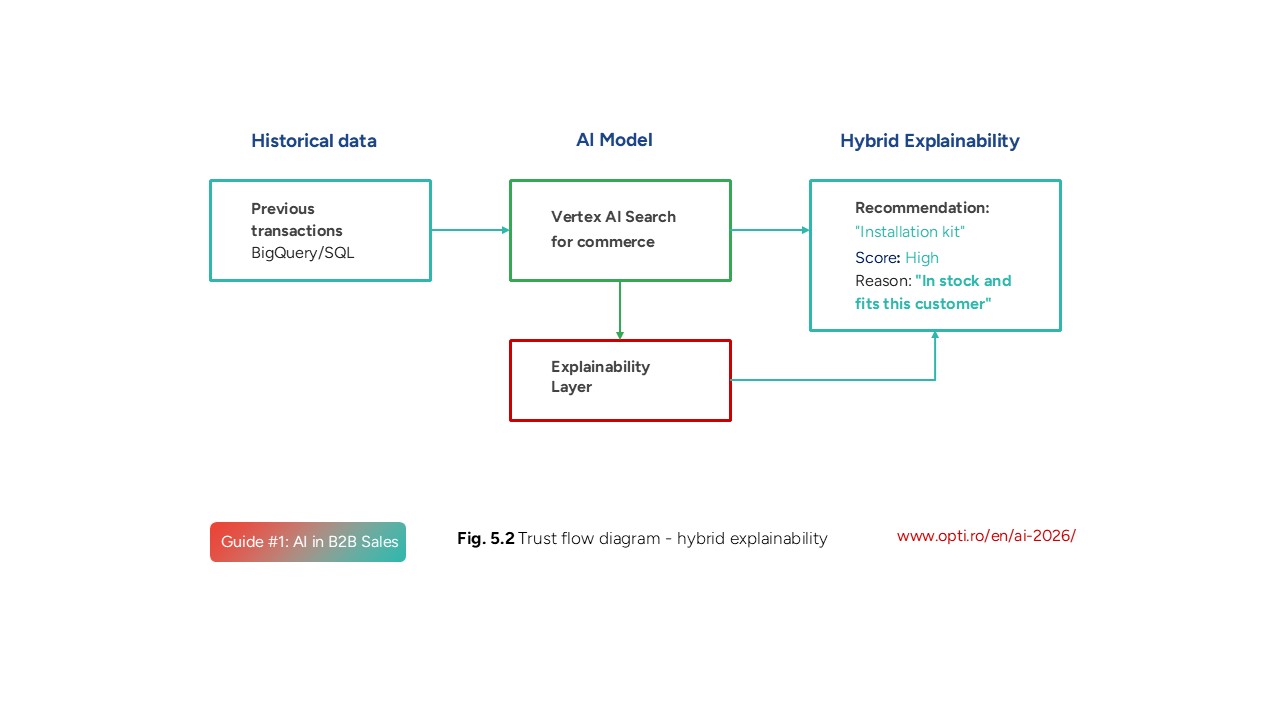
       HISTORICAL DATA                        AI MODEL                      HYBRID EXPLAINABILITY

┌───────────────────────────┐       ┌───────────────────────────┐       ┌───────────────────────────┐
│ Previous                  │       │                           │       │ RECOMMENDATION:           │
│ transactions              │ ─────>│ Vertex AI Search          │ ─────>│ "Installation kit"        │
│ (BigQuery/SQL)            │       │ for commerce              │       │                           │
└───────────────────────────┘       └─────────────┬─────────────┘       │ Score: High               │
                                                  │                     │ Reason: "In stock and     │
                                                  ▼                     │ fits this customer"       │
                                    ┌───────────────────────────┐       └─────────────▲─────────────┘
                                    │ Explainability            │                     │
                                    │ Layer                     │ ────────────────────┘
                                    └───────────────────────────┘
Company applications can be configured to display easy-to-understand hybrid labels (e.g., Best seller in stock, Frequently bought together by 102 people). Consequently, trust in AI will increase. When the sales rep can say to the customer "The system noticed that you bought X 2 months ago and now you might also need Y", they become a consultant.
In brief:
- Clean data and clarification of company flows are the foundation of any implementation.
- Commercial rules (guardrails) prevent so-called AI-assisted human errors.
- AI acceptance by the company team is supported by explainability.
- OPTI Software provides the tools and support needed for hybrid AI success.
What do we recommend at the end of the guide?
This guide and this chapter have described a structured way of adopting AI for company growth in 2026.
Returning to the metaphor from Ch. 2.5.2, imagine explaining to a person for the first time what you have in your company. Without abbreviations, without the procedural shortcuts developed over time, and without rushing. When you have finished the explanation, you are ready for AI, and you have additionally gained operational clarity.
The hybrid architecture will remain valid even when models, vendors, or channels change. It can deliver the benefits of AI with the stability characteristic of B2B.
Do you want an estimate for your company? OPTI Software can provide a free audit (Setup vs Run).
Continue Exploring
Quick Questions
Why is the Setup vs Run separation useful?
Because it clarifies what is initial investment and what is ongoing operational cost. Without this separation, AI appears financially unpredictable.
Why is the model not the dominant cost?
Because integration, data cleaning, business rules, and testing consume most of the effort. The model is only one component.
Which roles are required for success?
A business owner, a data owner, and a technical team that understands both ERP systems and AI limitations.
How are commercial risks reduced?
Through just-in-time checks for stock, pricing, and permissions, combined with auditability of automated decisions.
Is a single price for Setup and Run realistic?
From the client’s perspective, yes. Internally, the costs still exist, but they are absorbed and optimized differently.
What is the TLDR (conclusion)?
This chapter clarifies budget and accountability: build vs operate, why data and integration dominate cost, and how to prevent drift with ownership, audit and monitoring.
What technologies and methodologies are involved?
Technologies: Google Cloud, Vertex AI, BigQuery, Cloud Logging, Cloud Monitoring, IAM, KMS, CI/CD, Data Warehouse, ETL/ELT
Methodologies: CAPEX/OPEX budgeting, TCO model, roles and RACI, data governance, controls (stock/margin/permissions), SLO/SLA, change management, runbooks, audit and compliance (ISO 27001)