Brief of March 2026
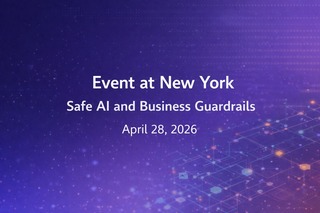
Google Cloud launches, New York event and B2B projects
In newsletter: Two case studies, MrBenny award and OPTI community.
See March Brief





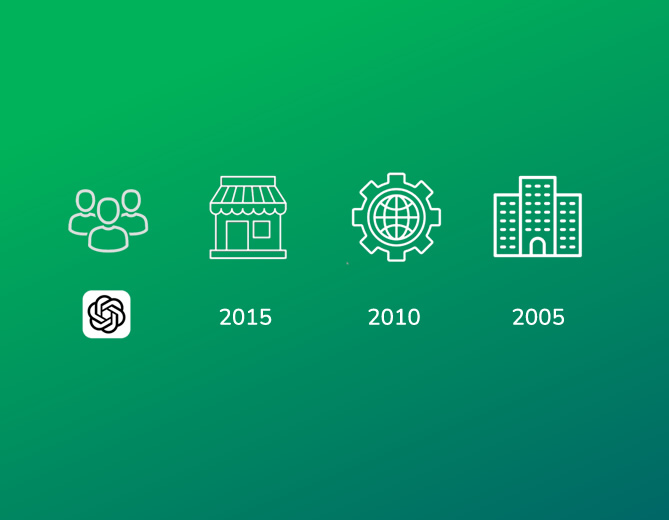
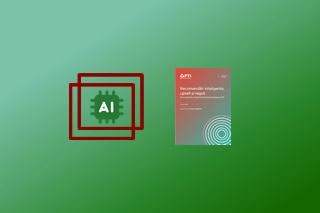
On Jan 21, the first guide for AI in sales was launched
In 2026, most companies still run legacy software (e.g. old ERP system) as their core software system. But customers and internal distribution and sales teams expect ecommerce speed and instant responses as to stock, price and product alternatives.
➤ Press Echoes (in Romania for the moment): A Topic of Public Interest
Even as almost all office workers use generative AI (like ChatGPT), with the associated security risks, the software their employers run in distribution, production, and sales is largely outdated.
We have conducted an analysis of companies opportunities and fears regarding AI implementation, along with six technical guides that show that hybrid architecture (AI + classic tech) is the only realistic option for large-scale AI implementation in manufacturing, distribution, and B2B sales.
This `open architecture` approach is illustrated for each technical guide with Google Cloud technologies and the AI Sales platform by OPTI.
Below you can find a preview of each guide. You can subscribe to receive the full technical guides before the public launch and see what an AI implementation in B2B looks like in practice.
Salespeople often forget active promotions and management’s sales strategy. Management often loses control over minimum and maximum prices or upsell opportunities. AI can solve both problems.
Generated by companies that excel at offer personalization.
Increase in average ecommerce order through personalization and AI suggestions.
Read Guide #1
Unstructured data (WhatsApp images, handwritten PDF lists, voice notes, public tenders) forces manual data entry, sometimes with human errors. AI can streamline this work.
Average cost (US) borne by a company for not correcting a data entry error.
Character recognition rate for high-quality scanned documents.
Error-free transcription at the individual-word level for clear audio, Google Speech-To-Text. Other models reach >94%.
Time needed to transcribe a list of 50 products from a handwritten image.
Preview Guide #3
Static software does not adapt to market volatility or changing inventory priorities. Hardcoded business rules may become obsolete. Implementing AI brings automated recommendations and self-adaptation, even day by day, with continuous intelligent reporting.
Companies with adaptive AI scale implementations much faster than competitors.
Revenue per online search increases through a culture of continuous A/B experiments.
Google Cloud AI systems (recommendations, chatbots) learn continuously from clicks and quotes.
ecommerce portal uplift after the technology upgrade.
Preview Guide #5
The customer searches for “screw hole”, should get what the ERP lists as “self-tapping screw.” The customer searches for “SKU-8521”, yet should not get “SKU-8522.” Hybrid search (a mix of classic lexical search and AI-semantic search) combines the advantages of both and can be robust for business uses. We document 40 applications and assistants (chatbots).
B2B buyers switch suppliers if the B2B online (including search) experience is better.
Higher for users who use search vs. browsing through the menu.
Reduction achieved by implementing the hybrid architecture.
Preview Guide #4
Companies cannot function without quality data. GenAI models will not be reliable if they are not grounded in company data, and hallucinations are unacceptable for data such as price and inventory. Hybrid architecture can solve both problems.
The average cost borne by a US company due to poor data quality.
Average time employees lose weekly searching for information across different systems.
94% factual answers in a complex RAG architecture, ~100% via SQL architecture for exact data: price, stock.
Data sync interval cloud - local ERP (with hundreds of thousands of products) into OPTI’s Google Cloud architecture.
Preview Guide #2
AI adoption raises concerns regarding the company data and standards: GDPR, NIS2 and ISO 27001 compliance. A “fortress” architecture can provide by-design safeguards.
Innovative companies use confidential information and trade secrets.
IT leaders are concerned about AI "audit trail" and transparency in their company.
Increase in cyberattacks using AI agents worldwide in 2025.
Cloud data can be stored in the EU (Frankfurt/Warsaw), OPTI is ISO 27001 certified.
Preview Guide #6
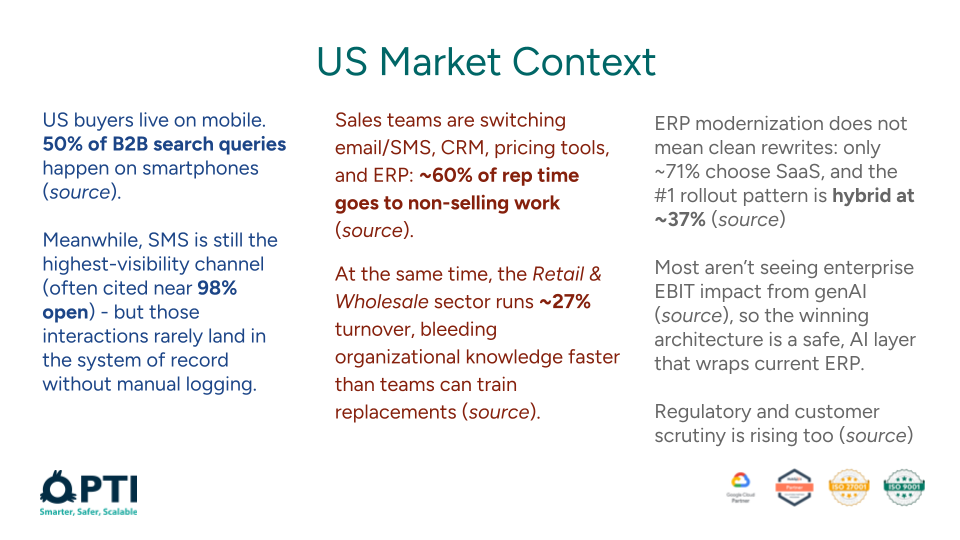
US buyers live on mobile. 50% of B2B search queries happen on smartphones (source).
Meanwhile, SMS is still the highest-visibility channel (often cited near 98% open) - but those interactions rarely land in the system of record without manual logging.
Sales teams are switching email/SMS, CRM, pricing tools, and ERP: ~60% of rep time goes to non-selling work (source).
At the same time, the Retail & Wholesale sector runs ~27% turnover, bleeding organizational knowledge faster than teams can train replacements (source).
ERP modernization does not mean clean rewrites: only ~71% choose SaaS, and the #1 rollout pattern is hybrid at ~37% (source).
Most aren’t seeing enterprise EBIT impact from genAI (source), so the winning architecture is a safe AI layer that wraps current ERP.
Regulatory and customer scrutiny is rising too (source).
The study "AI Architecture for B2B in 2026" opened a necessary conversation about the gap between the speed of employees and the infrastructure of companies.
The Romanian coverage of our analysis by over 15 central (Agerpres, Wall-Street) and specialized (TechRider, ClubITC) publications confirms that the tension between legacy systems (ERP) and new AI technologies is a systemic reality.
"AI for 'blue collars': how algorithms are changing work in production and distribution."
5 jobs that increase sales in production, distribution, and pharma
"AI in sales: the opportunity for +40% revenue that many companies miss."
"Artificial intelligence, between the notebook and WhatsApp. Where the technological chain gets stuck."
"Employees are starting to use artificial intelligence, but firms stick to the notebook."
"Why do companies want AI in 2026? 3 identified opportunities."
"Employees use AI, but companies remain stuck in technologies from 25 years ago."
"3 opportunities and 3 fears of B2B companies regarding AI."
Other relevant coverage:
No. Hybrid Architecture means an intelligent middleware layer. It connects to your existing ERP (SAP, Microsoft, Senior, Charisma) via API or read-only access, augmenting it with AI capabilities without disrupting core operations.
It is a system that combines the stability of traditional SQL databases (for exact pricing and stock) with the flexibility of Vector Search and LLMs (for understanding natural language user intent and synonyms).
Using multimodal AI models, the system can 'read' images of handwritten notes or listen to voice messages, extracting product SKUs and quantities to automatically populate ERP orders.
Yes, if implemented correctly. You can use a 'fortress' security architecture, such as Virtual Private Clouds (VPC) and strict data residency within the EU, ensuring compliance with GDPR and NIS2 standards.
After 2026, the gap between 'AI-native' new businesses and legacy-software traditional distributors will become insurmountable. Early adopters of hybrid architectures will see market competitivity and efficiency.
In a hybrid architecture, this is prevented by RAG (Retrieval-Augmented Generation) and SQL by-design verifications. The AI is technically restricted from inventing numbers; it must retrieve the exact figure from your ERP-originated database before answering.
The technology to bridge the gap between static ERP data and dynamic market demands exists today. Adopting a hybrid architecture allows B2B companies to scale sales operations without discarding their foundational systems.
Technologies: Enterprise resource planning, Artificial intelligence, Google Cloud Platform, Middleware, Generative AI
Methodologies: Hybrid Architecture, Legacy System Integration, Multimodal Processing, Retrieval-Augmented Generation (RAG), Data Sovereignty, Operational Automation

Article written by
Manager, Software Architect, PhD. in Logic, Fulbright Visiting Scholar (CUNY GC, 2023)
See on LinkedIn →