
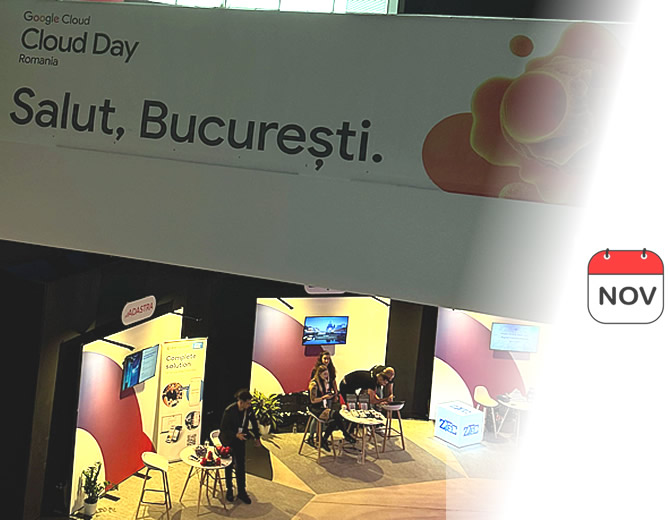


On November 5, 2025, the tech community gathered at Google Cloud Day Bucharest (as OPTI announced here). The atmosphere was one of pragmatic optimism: we’ve moved past the AI “hype” phase and entered the stage of implementation and scaling alongside big players like BCR, Superbet, and eMag.
But the story wasn’t written only on the stage at Cineplexx Băneasa, but in the weeks that followed. Google delivered, at an accelerated pace, exactly the tools needed to turn vision into operational reality, including for small and medium-sized businesses.
In this article, we analyze the impact of the local event and decode the three global launches that completely change the “game” in less than a month: File Search, Gemini 3 and Workspace Agents.
Echoes from Bucharest: Tech Flexibility and Accessible AI
The general feedback from participants confirmed that the Romanian market is ready. We’re no longer talking about “if” we use cloud and AI, but about “how” we integrate it without getting stuck in rigid ecosystems.
A key observation came from the analysts at PAC - SITSI Platform, who noted a major differentiator for Google in the local market:
"...a client was asked why they chose Google Cloud over competitors. The answer highlighted the availability of open-source technologies, which allow the company to reduce dependence on a single vendor and promote long-term operational agility." Source: SITSI Blog➛
Aurora Rizea captured the new reality perfectly: AI is no longer only for corporations with R&D budgets of millions of euros, she writes (in Romanian)
"Everyone talks about and tests AI, but for small businesses, it’s a real chance to grow, even with normal budgets. AI in e-commerce is exactly what you need to grow." Source: Instagram➛ / LinkedIn.
At OPTI, we built the quoting software Sales with AI exactly on this logic. The democratization of enterprise technologies, like Vertex AI Search for Commerce, for distributors and retailers who want to increase basket value.
From Promises to Code: Three Crucial Launches in One Month
Immediately after the event, Google delivered at an accelerated pace all of the below in less than one month.
1. November 6: File Search (Democratized RAG)
Just one day after the event in Romania, Google launched in public preview the File Search functionality for the Gemini API.Until now, to build a system that “talks to your documents” (RAG - Retrieval Augmented Generation), you needed vector databases and custom data pipelines. Now, Google offers RAG “as a service.” You can upload PDFs, DOCX files, or CSVs, and the model answers while citing the exact source.
We have already tested the technology and documented how it can be integrated with data from a CRM like HubSpot in a dedicated article:
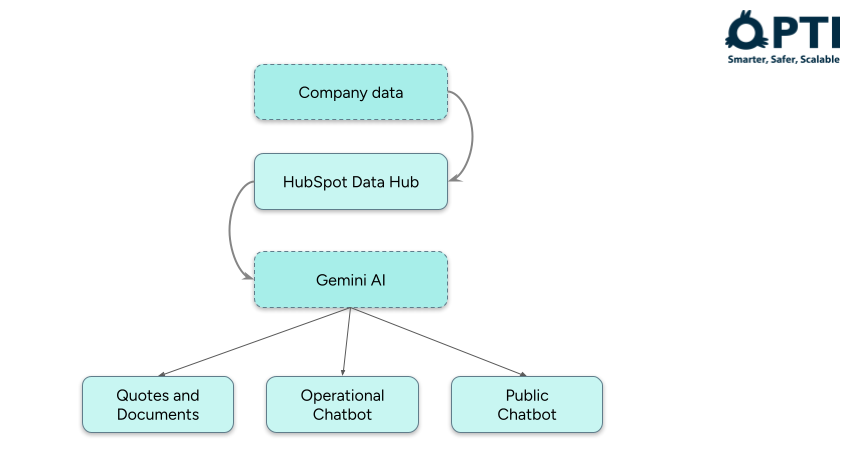
👉 See our analysis: Practical Guide for HubSpot Data Hub and Google Gemini AI File Search.
Moreover, RAG is the foundation for integrating AI into “Single Source of Truth” flows. It allows companies to build internal assistants that know the company’s procedures, without writing thousands of lines of code.
2. November 18: Gemini 3 Pro Preview - The New LLM Leader
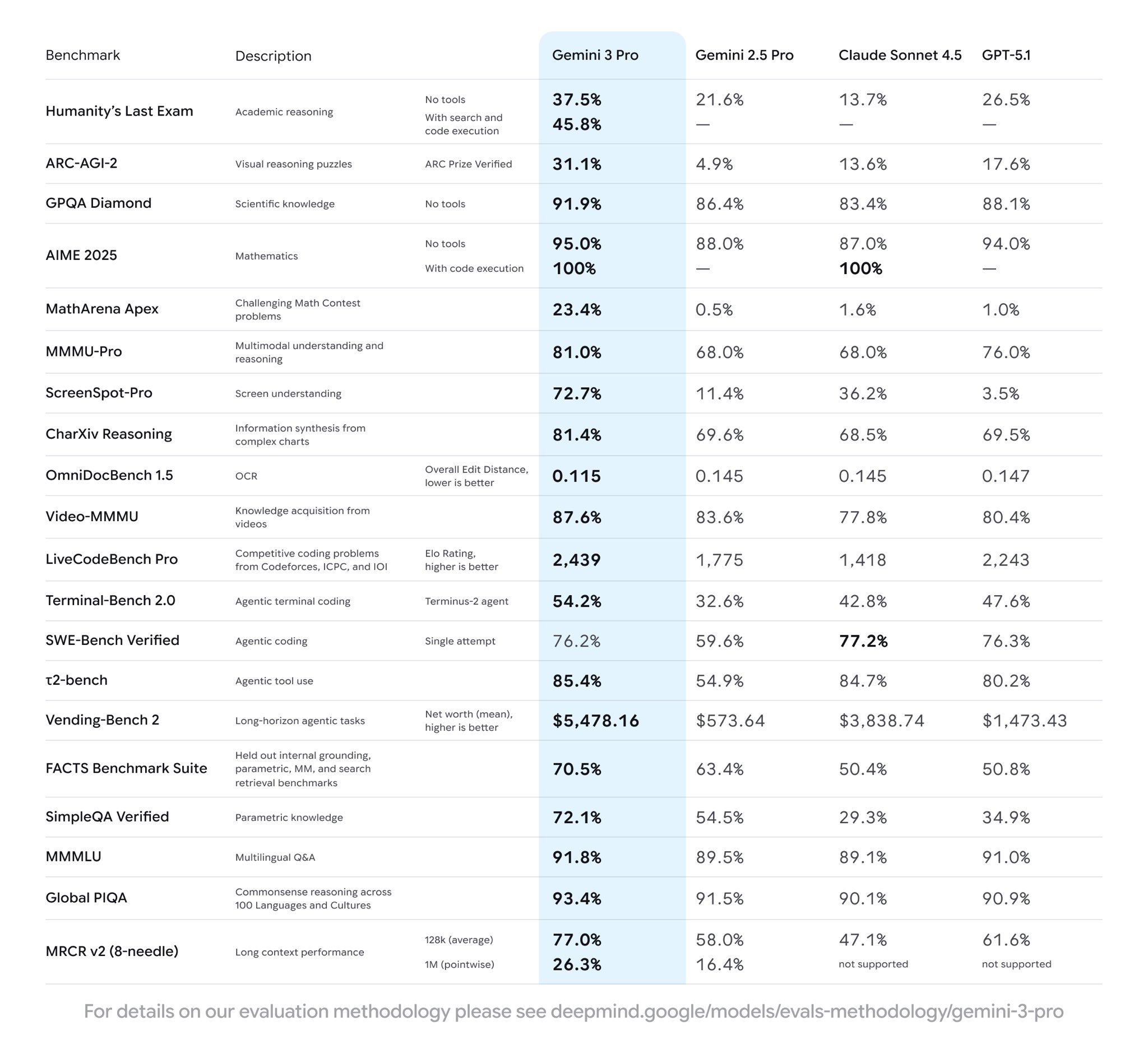
Google surprised the industry by launching the preview for Gemini 3. The performance leap is significant. According to benchmarks, Gemini 3 dethrones competitors, achieving a score of 1501 points on LMArena (link) and outperforming previous models in mathematical, spatial, and coding reasoning.
The echoes are countless; among them, it’s worth highlighting the multimodal and OCR capabilities. The expert @pontusab showed how Gemini 3 reads handwritten invoices almost perfectly, eliminating the need for dedicated OCR software.
Gemini 3 for OCR on invoices and receipts is insane. pic.twitter.com/nHjdvMWFmQ
— Pontus Abrahamsson — oss/acc (@pontusab) November 23, 2025
Is it a perfect model? The technical community, including experts such as @VraserX, noted that although the model is exceptional in standard tests, it seems to be slightly “overfitted” (over-optimized) for them, requiring very clear prompts for unconventional tasks.
Gemini 3 is a genuinely solid model in some areas, especially coding and spatial reasoning.
— VraserX e/acc (@VraserX) November 19, 2025
But the pattern that’s emerging across community tests is… interesting.
As soon as you move outside the benchmarks it was clearly trained on, Gemini 3 starts slipping. And not just a… pic.twitter.com/tRGoL8VJlz
In conclusion, Gemini 3 is an almost incredible tool for logical or structured tasks. For applications that require rigor, it is the new standard and can be used immediately, but we are waiting for the Flash version for production rollout in operational flows.
For system architects, choosing the right model (e.g., Gemini 1.5 Flash for speed vs. Gemini 3 for complex reasoning) will be a cost and performance decision.
👉 Find out how we can help you build the right infrastructure on our Data processing in Google Cloud page.
3. Last But Not Least: December 3: Agents in Google Workspace
Perhaps the most relevant launch for day-to-day operations: Google Workspace Studio. Now, there will be no need for writing code to build AI agents directly into the Workspace ecosystem (e.g. Docs, Drive, Gmail). AI agents have been democratized for anyone who understands their own work flows and security aspects (e.g., permissions).
Here are a few officially available templates (link), ready to be activated immediately to eliminate operational noise:
- Inbox management: You receive a daily summary of unread emails.
- VIP prioritization: You receive specific notifications only for emails from key people
(clients, management).
- Automatic triage: The AI labels on its own the emails that contain requests or tasks
“action items”.
- Follow-up management: Automatically starring (Star) messages that require a later
follow-up.
- Calls and meetings assistant: Sending the summary and agreed actions to participants
immediately after the meeting.
- Press monitoring: Daily summary with news relevant to your industry.
The tech analyst @signull summed up brutally the economic impact of this launch:
"Do you remember that operations person who manually processed feedback, triaged the inbox, summarized replies, updated Excel files and moved tickets? That person is no longer needed for these tasks. [...] The long tail of grunt work is eaten by a small LLM + triggers."
yo, remember that ops person who manually processed feedback, did inbox triage, summarized responses, updated sheets, nudged people, & moved tickets amount other things? yeah, that person is no longer necessary.
— signüll (@signulll) December 3, 2025
however you feel about it the economic reality is simple.. the long… https://t.co/mv10ALNmEQ
This is the future of multimodal input and automation. People no longer have to move data from an email into an Excel file. People can think strategically, and AI agents can do the repetitive tasks.
👉 Find out how we apply this in order processing in Guide #3: Multimodal Input.
👉 For more automation scenarios, visit our page Automations and AI Agents.
From "Wow!" to "This is How!"
Google Cloud Day 2025 was the moment of inspiration. The month that followed can be seen as a key moment for the democratization of AI technology. We have the data infrastructure (File Search), we have incredibly intelligent models (Gemini 3), and we have operational agents (Workspace Studio).
The challenge for 2026 is no longer access to technology, but integrating it into a coherent and secure architecture. For a solid infrastructure, you can explore our series of Technical Guides 2026, where we explain how we connect these Google innovations to the reality of existing B2B ERPs and processes.
👉 See the Guides on AI in B2B Software for 2026.