





The ability to forecast your monthly revenue plays a huge role in your company's long-term success.
Accurate monthly revenue forecasts allow you and other members of your management team to make better strategic decisions concerning departmental budgets, recruitment, expansion, acquisitions, and your overall growth trajectory.
Just as importantly, revenue forecasts highlight potential problems before they spiral out of control. If, for instance, you notice your sales team has consistently been 20% below their quotas, you need to determine the reason and correct course before the issue becomes worse.
With this in mind, let’s look at how to forecast your monthly revenue with Hubspot.
1. Establish a Consistent Sales Process
Firstly, you need to ensure your sales department employs the same sales process. Without a standard sales process, it’s more difficult to determine the probability of each lead/prospect in their respective pipelines resulting in a sale – and, subsequently, to forecast your revenue for next month. This includes establishing a company-wide definition of a lead, prospect, closed deal, etc.
2. Set a Confidence Rating for Each Deal
Ask each sales rep to attach a confidence rating for each prospect in their pipeline. This establishes how confident the sales rep is in a prospective deal going through and resulting in revenue. For forecasting purposes, this confidence rating adds a weighting to each sales opportunity: with those in the early stages having a lower weighting and those close to being closed receiving a higher rating. This allows you more accurate forecasting and gives your sales teams ownership in the forecasting process.
3. Choose a Revenue Forecasting Method
Reliably predicting your monthly revenue is defined by the forecasting method you use. Each different method provides a varying set of metrics on which to base your revenue forecasts. These include:

- a. Opportunity Stage Forecasting: this accounts for the stage of each sales opportunity in your sales teams’ collective pipeline. The further along an opportunity in the pipeline, the likelier it is to result in revenue.
- b. Length of Sales Cycle Forecasting: the amount of time it takes for a deal to go through depends on the industry you’re in. Subsequently, this method uses the age of opportunities to predict when they're likely to result in revenue.
- c. Intuitive Forecasting: this relies on the estimated likelihood of a deal closing within the forecasted month, as well as how much it’s likely to be worth. This method relies on the previously mentioned confidence rating set by your sales reps.
- d. Historical Forecasting: this is a quick and simple way that forecasts revenue based on sales from the previous month, quarter, or the same period in previous years. You can also enhance this method by applying a growth metric, e.g., based on your company’s performance.
4. Consult Other Departments
Although data from your sales department is vital for monthly revenue forecasting, other departments within your company can also prove instrumental. These include:
- a. Marketing: is your marketing department rolling out a new campaign or strategy that will influence the number or quality of sales opportunities?
- b. Product: is your product department amid a product launch that will boost sales?
- c. HR: is your company going on a hiring spree? If so, additional personnel, particularly sales reps, is sure to impact your revenue and this needs to be reflected in your revenue forecast.
Hubspot’s Forecasting Tool
As well as the techniques outlined above, you can also use the dedicated forecasting tool in Hubspot’s Sales Hub to predict your company’s monthly revenue.
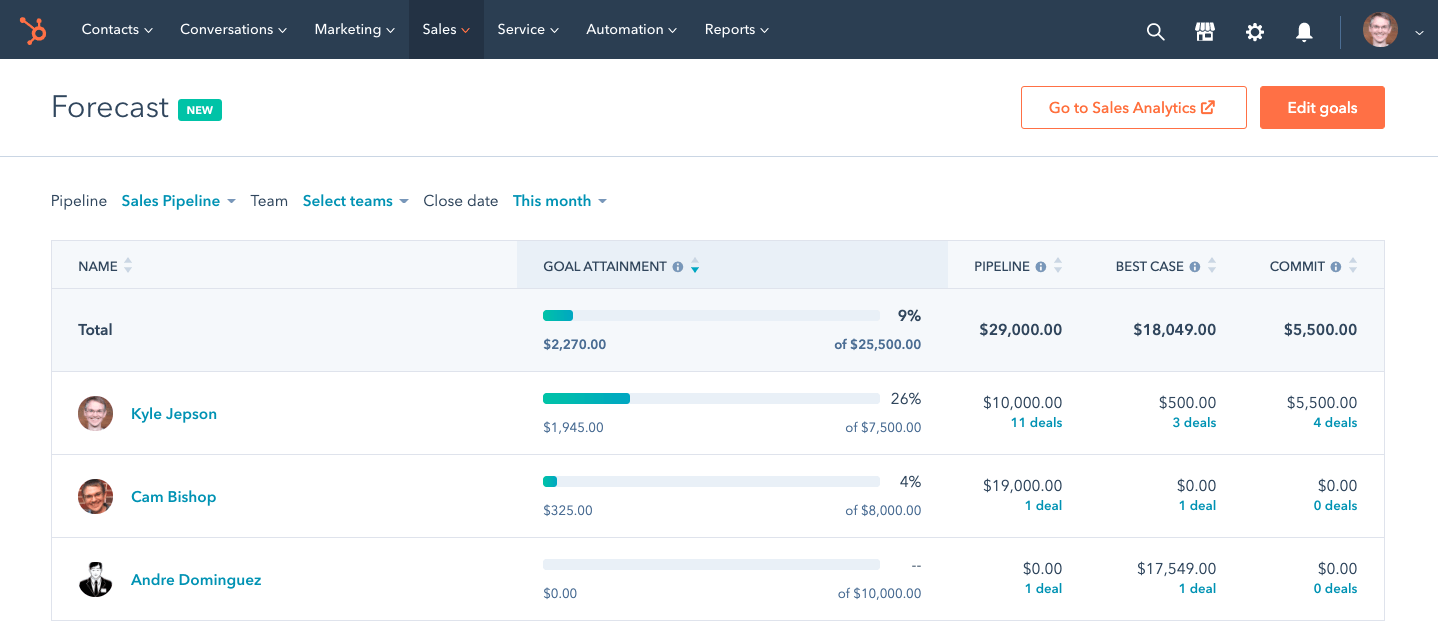
Hubspot’s forecasting tool allows you to forecast the monthly revenue for sales reps in your company– as well as for any other length of time, i.e., quarterly, annually, etc. The forecasting tool allows you to create monthly revenue forecasts down into three categories: Commit, Best Case, and Pipeline.
- Commit: this forecasts revenue based on sales opportunities most likely to close. This, again, is tied to each opportunity’s given confidence rating.
- Best Case: this includes all the sales opportunities in the Commit category in addition to those that are expected to result in revenue if everything goes to plan in the sales process.
- Pipeline: the total value of all opportunities with close dates in the next month.
Although many companies shy away from forecasting their monthly revenue, or persistently operate on inaccurate forecasts, due to their perceived difficulty, it can be done far more efficiently with the right process. More importantly, forecasting your monthly revenue is made all the more simple with the right tool – which is where Hubspot’s Sales Hub proves extremely useful.