
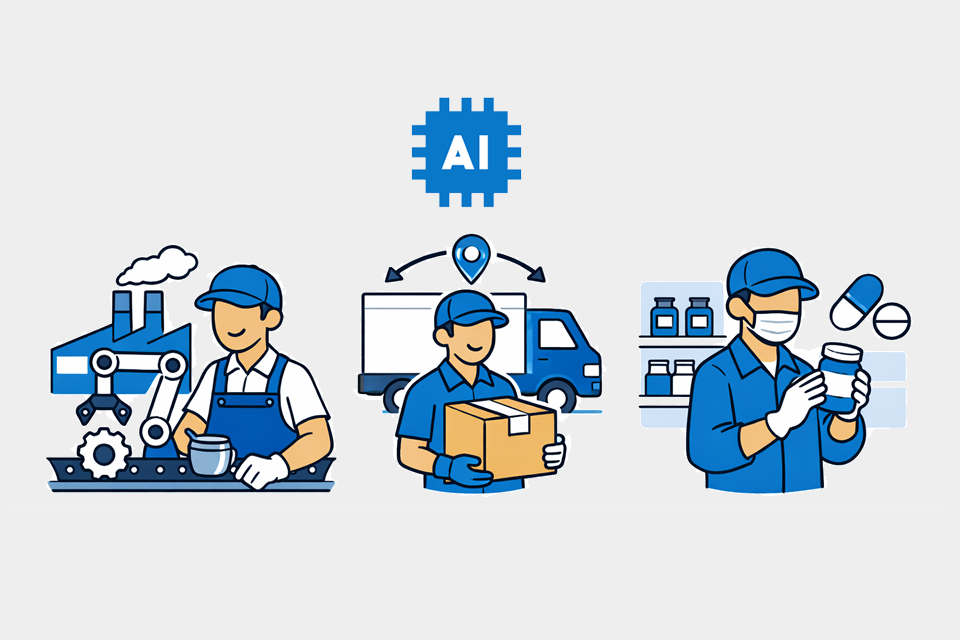


The IT market is saturated with AI for the office activities of "white-collar" workers (fr. Col blanc): generating emails, programming code, images and reports. What we bring to market with the series of technical guides "AI 2026 in B2B" is artificial intelligence for the backbone of the economy. This means:
- Distribution: the movement of physical goods that reach the corner shop
- Manufacturing: bringing new physical products to market
- Any business-to-business negotiation: meeting contractual conditions for stock, price and quality.
AI Engineering
Traditionally considered "blue-collar" (fr. Col bleu), essential B2B activities depend on engineering, not magic. This is why we are publishing five projects drawn from the 10 in OPTI Guide 1 - AI for Sales.
Each project includes an architecture diagram in which we highlight the business rules that must be respected. This approach: artificial intelligence controlled by rule-based systems is the hybrid architecture we propose to the market.
"This guide proposes a pragmatic approach: hybrid architecture. You do not need to replace your current systems. A layer of intelligence will be built on top of existing data, generating new sales, under the strict control of business rules: minimum margin, stock levels, technical compatibilities, permissions."
Dr. Marian Călborean, Fulbright scholar, founder of OPTI Software
Copilot for Sales Agents
Recommended for teams with junior sales agents. Attention is required when implementing in legacy ERP systems to really be of help to the agent.
Side panel in CRM or ERP, or as an overlay over legacy Windows systems (e.g. AS/400, old Epicor instances)
What does AI do?
It recommends contextual upsell or cross-sell to the agent, e.g. during a call. With a custom model, it also recommends the best action (Next Best Action Model), e.g. "send them an email"
A chatbot (assistant) can also be added.
Ideal industries
Distribution of technical equipment (HVAC, Electrical) and Automotive parts
These are sectors where the catalogue contains thousands of references, and the training period for a new agent easily exceeds 6 months.
Logic flow
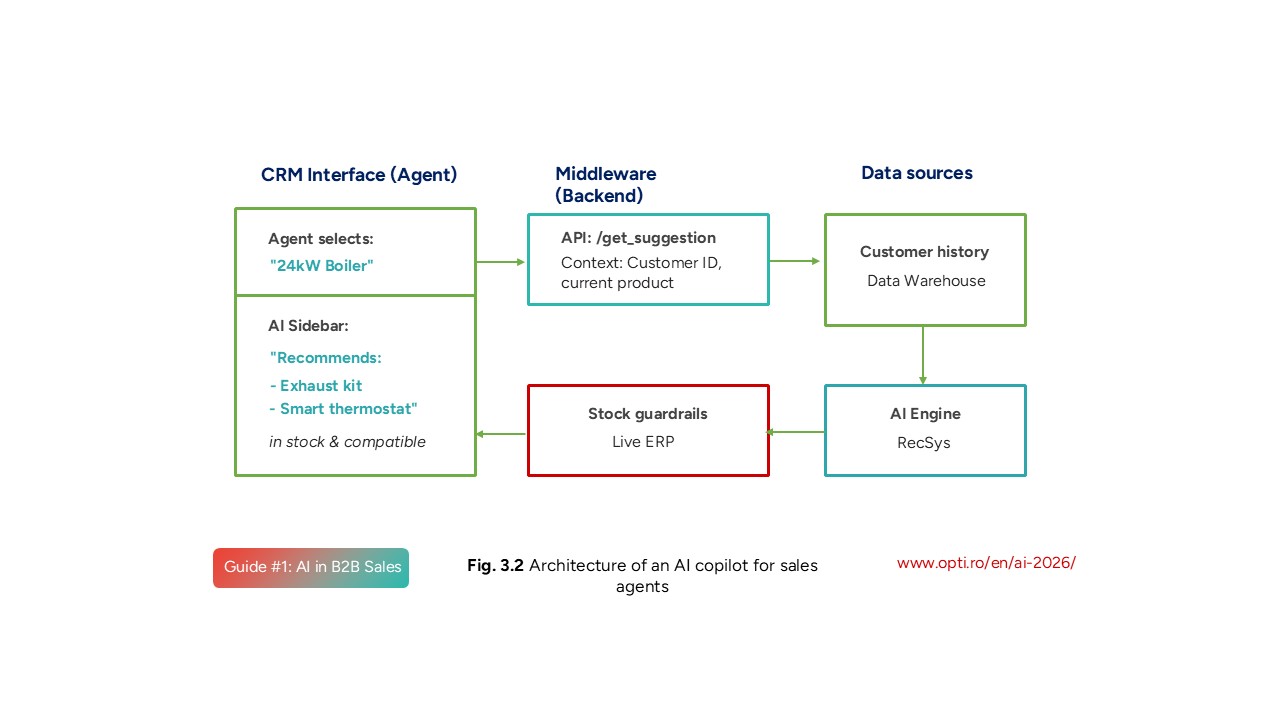
See in the guide: ROI indicators for shortening the learning curve of junior agents
Smart Substitutes Engine
Killer app for everyone who loses customers when out of stock. Probabilistic AI is not sufficient here; we recommend clean data, a product specification sheet and a classic constraints engine.
Product substitution when out of stock, for faster rotation or for delivery from a single location.
What does AI do?
Saving the sale when stock is 0 (e.g. automotive, IT, construction, pharma) due to supply or rapid distribution issues.
Transport optimisation when multiple locations exist (WMS).
Ideal industries
Construction materials distribution, Restaurant Supply, Medical and Pharma
Construction sites and end-users cannot wait, and a stockout in the presence of valid substitutes immediately results in losing the customer to the competition.
Logic flow
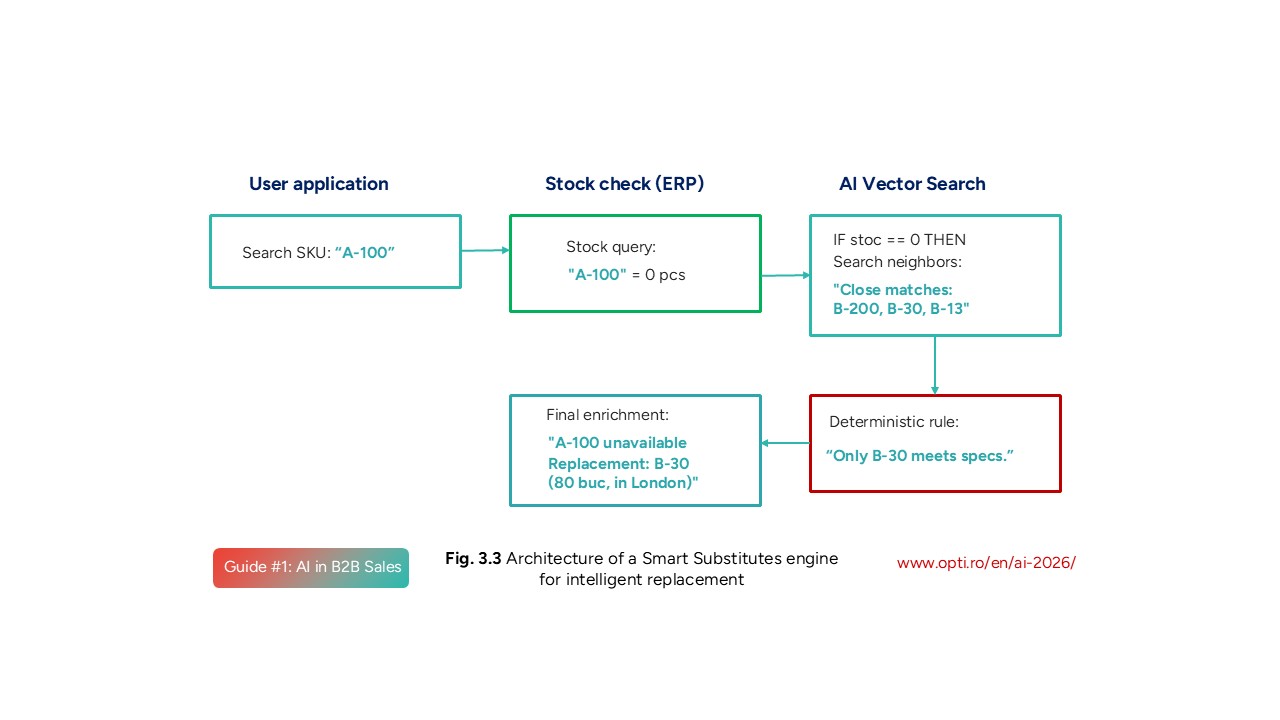
See the deliverable and why probabilistic AI is not sufficient without rules (guardrails)
Dynamic Bundle Generator
Effective in B2B. The key is that the discount should not be visible per product on the invoice, but global, so as not to accustom the customer to discounted prices.
Creating dynamic bundles to increase rotation without undermining positioning
What does AI do?
Suggests bundles of a bestseller plus a slow-moving product based on conversion probability (pCVR).
A discount is applied to the bundle (classic or with an AI model).
Ideal industries
FMCG (fast moving consumer goods), IT and electronics, Beauty / Cosmetics.
There are always stocks with short expiry dates or high-margin accessories to clear.
Logic flow
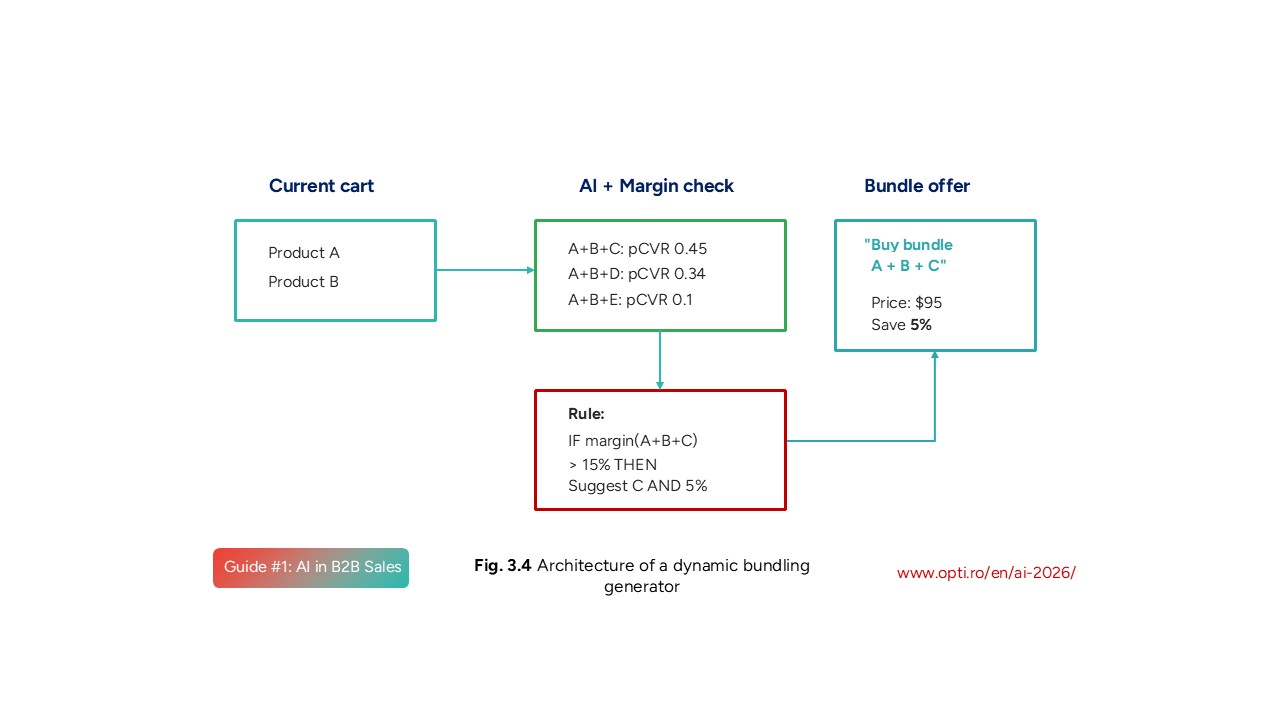
See in the guide the indicators that distinguish a bundle from a simple price reduction
"Frequently Bought Together" Module with Compatibility Awareness
Should be industry standard. Pay attention to volumes: if someone has already bought 1000 screws, the correct recommendation is an equal number of washers or screwdrivers, not more screws.
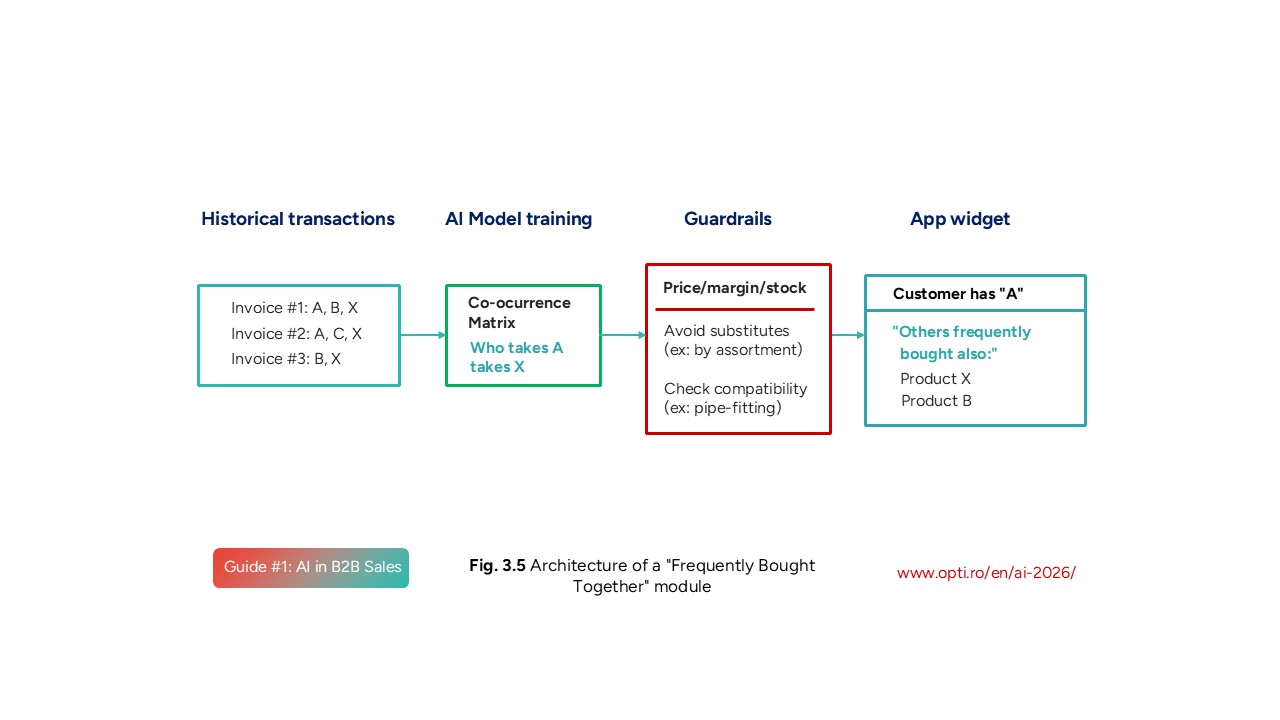
The classic "Customers who bought this also bought..." from sites like Amazon, but calibrated for B2B (industry and distribution).
What does AI do?
Identifies strong correlations (e.g. "Customers who buy pipe also buy fittings") based on historical orders. The model is trained on the transaction history of the past several years.
Ideal industries
DIY / Home Improvement, Plumbing and Heating Installations, Furniture Industry
Sectors where products are interdependent (e.g. pipe + fittings), and a wrong recommendation blocks the customer's project.
Logic flow
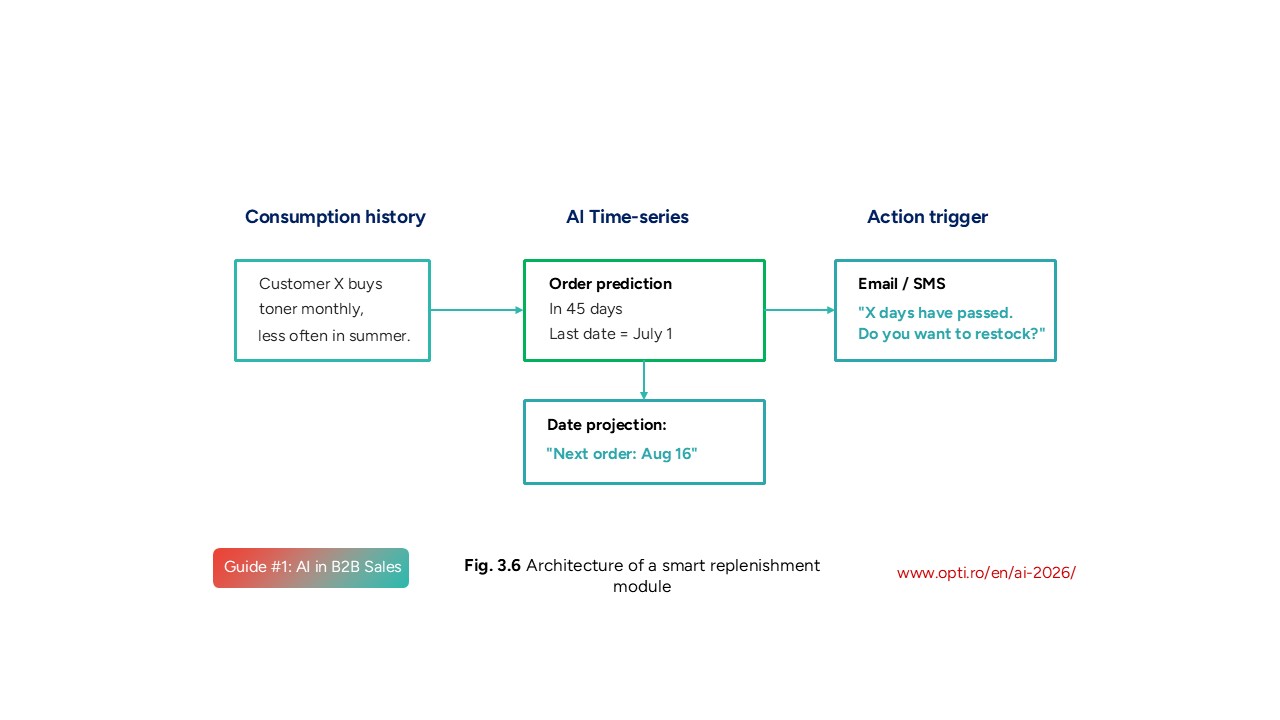
Intelligent Replenishment
Can dramatically increase sales. AI is the only method that detects real seasonality without a fixed recurring interval (e.g. August and November in agriculture).
A system that learns the consumption cycle of each customer and proposes replenishment
What does AI do?
Predicts the date a customer's stock will run out and sends a proactive reminder (e.g. email).
If a farm buys seeds seasonally, the system alerts it (for fixed-cycle repetition, non-AI methods exist).
Ideal industries
Agriculture, Stationery and Office Supplies, Pet food / Veterinary
They have either climatic seasonality or recurring consumption with seasonal influences (e.g. tax filing season).
Logic flow
Four ideal industries for AI - read the guide:
AI in Wholesale: Technical and IT Distribution
AI in Healthcare: Medical Equipment and Pharmaceutical Supplies
AI in Construction: Building Materials
AI in Agricultural Inputs: Seeds, Fertilisers, Treatments
Predictive AI vs Generative AI
The market today is flooded with generative AI solutions (such as ChatGPT), excellent for writing emails, generating images or summarising texts.
Our guide focuses on predictive AI. It does not hallucinate texts. It analyses millions of historical transactions to anticipate the next step: which stock will run out, which customer will churn, which product is compatible.
On top of predictive AI, generative applications such as assistants and chatbots can be built, and in the future AI agents. Always with the strict application of the company's business rules.
In B2B, engineering matters. We must know, in order to foresee, in order to act (fr. "Savoir, pour prévoir, afin de pouvoir." - Auguste Comte)
Discover all 10 deliverables by reading the OPTI guide